 Русский
 Қазақша
 Eesti
USD/KZT cross-rate analysis
How do Raison analysts assess the outlook for the exchange rate?
The significant volume of potential dollar supply from the National Bank remains on Kazakhstan’s foreign exchange market. In October, net foreign currency supply under gold purchase mirroring operations, including offsetting purchases for the UAPF (Unified Accumulative Pension Fund), amounted to about $102 million in our estimate. Additional foreign currency sales equivalent to 302 billion tenge (about $670 million) are scheduled for November. In addition, the NBK purchased $910 million from the National Fund for subsequent sale on the domestic market.
Thus, the combined potential supply from these two latest channels amounts to about $1.6 billion, which creates a potential support factor for the tenge through year-end. At the same time, we note that this amount is the gross volume of expected sales, not net foreign currency supply (not the entire amount is necessarily expected to reach the exchange by year-end: the timing and volume of sales will depend on market conditions).
Monetary policy — maintaining the interest rate differential in favor of the tenge
The U.S. Federal Reserve. Despite Kevin Warsh’s more hawkish rhetoric and ongoing inflation risks, there is still no clear scenario for an aggressive increase in interest rates. According to FedWatch, the market is largely expecting a 25 bp hike at the December meeting. At the same time, the Fed’s hawkish rhetoric may serve as an additional tool to curb inflation expectations and tighten financial conditions without the need for a prolonged rate-hiking cycle, provided there is no new inflationary impulse.
The National Bank of Kazakhstan. On October 23, the NBK cut the base rate to 15.75%, noting slower inflation while elevated pro-inflation risks remain. The regulator explicitly indicated a low probability of any rate change through the end of 2026, effectively signaling a pause in the monetary easing cycle.
Conclusion: despite the expected 25 bp Fed rate hike in December, Kazakhstan’s monetary conditions retain an advantage in expected real yield. When comparing base rates with inflation expectations for the next 12 months, the real interest rate differential is about 3.31 pp in favor of the tenge (using the Fisher equation, assuming a 25 bp Fed rate hike in December).
Inflation expectations among professional market participants in Kazakhstan are 9.5% for end-2026 and 8.3% for end-2027, indicating continued disinflation is expected. Against this backdrop, nonresidents remain interested in Kazakhstan’s government bonds: in October, the value of their holdings increased by $261 million, and since the start of the year by about 865 billion tenge.
Accordingly, the attractiveness of tenge-denominated instruments reduces the likelihood of a significant capital outflow solely due to changes in monetary conditions. Through year-end, monetary policy is more likely to act as a factor supporting the tenge than as a source of pronounced pressure on the national currency.
Improvement in the trade balance and current account — a factor supporting the tenge
High global oil prices support Kazakhstan’s export revenues and create conditions for additional foreign currency supply. From January through August 2026, exports increased by 19.5% y/y to $60.4 billion, while the trade surplus rose by 82.2% to $17.8 billion.
In the first half of 2026, the current account posted a surplus of $2.4 billion versus a deficit of $3.6 billion a year earlier. The main contribution came from the expansion of the positive balance in goods trade, which offset negative flows in other current account items.
Improvement in the trade balance and current account creates fundamental conditions for tenge stability, as it indicates higher foreign currency inflows relative to the country’s external payments, reducing potential pressure on the national currency.
Risks to tenge stability
Despite the favorable combination of fundamental and monetary factors, risks remain that could limit further tenge appreciation or lead to its weakening.
Oil market conditions. The increase in Kazakhstan’s export revenues in 2026 was driven mainly by higher oil prices. From January through August, the value of oil exports rose by 16.3% y/y, despite a 3.6% decline in physical shipment volumes. Therefore, a decline in global oil prices or a further reduction in export volumes could weaken the positive effect of the improved trade balance.
Foreign exchange flows. Additional dollar supply from the NBK is not guaranteed in full through year-end. At the same time, a possible increase in foreign currency demand from the corporate sector and nonresidents could partially offset support for the tenge.
External monetary conditions. A tighter-than-expected Fed policy, higher U.S. bond yields, or a deterioration in global risk appetite (amid rising inflation) could reduce the attractiveness of tenge assets for foreign investors.
Our USD/KZT forecast range
Despite the favorable fundamental backdrop, we do not view a significant further strengthening of the tenge as the base case. Positive factors are already largely reflected in the current exchange rate, so in our view, maintaining current conditions will mainly support stabilization.
In the base case, we expect USD/KZT to remain in the 445–465 tenge range at the end of December 2026:
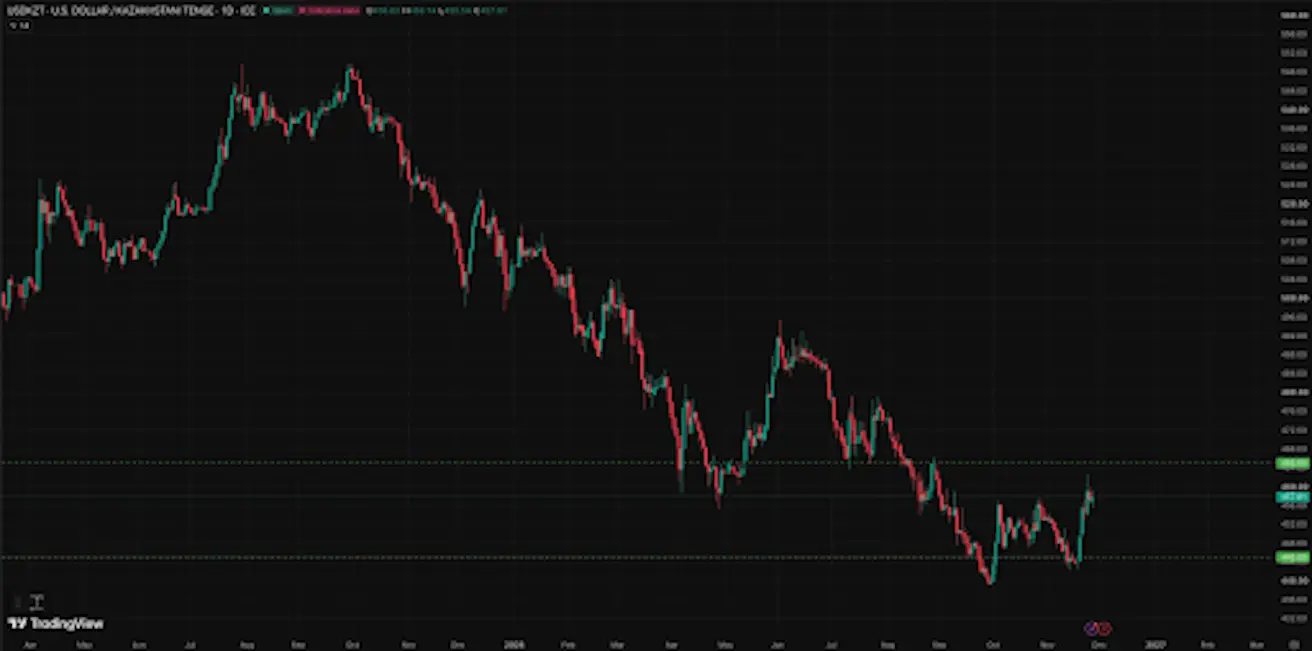
Further tenge strengthening to 430–445 is possible if net dollar supply in the domestic market increases and foreign capital inflows strengthen. At the same time, a reduction in foreign currency sales, higher offsetting dollar demand, or a deterioration in external conditions could lead to a weakening of the national currency to 465–490.
Market benchmarks and USD/KZT scenario forecast
According to the Bloomberg FX Rate Forecast Model as of November 26, 2026, the consensus analyst forecast for December 31 is 479 tenge per dollar, the forward rate is 463.52, and the statistical one-standard-deviation range, calculated based on historical volatility, is 450.33–476.72 (model probability 69%).
This material does not constitute financial, legal, tax or personalized investment advice, or a recommendation to enter into any specific transaction. Returns and estimates do not guarantee a profit; actual results may differ. Marketing communications do not constitute an offer to sell or a solicitation of an offer to buy securities or other financial products. Offers are made only on the basis of the applicable documentation and where permitted by law.