 Русский
 Қазақша
 Eesti
FOMC Meeting Summary: October 2026
The rate was held within its current range
Yesterday, the FOMC held its third meeting under Chairman Kevin Warsh and kept rates in the 3.75–4.00% range. The decision passed 10 to 2 (Lisa Cook and Beth Hammack voted for a 25 bps hike).
Key points from Kevin Warsh’s opening statement
- Economic activity is growing at a strong pace, and domestic spending remains resilient. Business investment is expected to grow at a double-digit rate, and capital expenditures account for a historically high share of GDP.
- Inflation remains elevated, but inflation expectations are moving in the “right direction”, and the labor market is solid.
Takeaways from the press conference
Warsh’s answers to journalists’ questions revealed a noticeable gap between declared resolve and actual readiness to act, which reinforces our September hypothesis of preemptive verbal tightening.
In September, the reasoning went like this: inflation has been too high for too long; financial conditions are not restrictive enough; therefore, action is needed. Warsh was trying to convince the market of the Fed’s resolve to fight inflation.
In October, the underlying conditions have not fundamentally changed (again, according to Warsh): inflation remains above target, the economy is strengthening, and financial conditions have not yet become truly tight.
Yet the Fed chose to pause. This suggests most Committee members do not yet see the need to enter a sustained cycle of rate hikes.
The first shift in rhetoric was also noticeable: Warsh said the measures already taken are starting to work, although there isn't yet enough data to draw final conclusions.
He also gave an interesting answer about the state of the economy: Warsh does not believe that strong economic growth in itself becomes a source of inflation. The Fed does not necessarily have to slow down economic activity to achieve price stability.
Main takeaway: softer rhetoric and a wait-and-see stance for now
Despite some softening in Warsh’s rhetoric, there are not yet sufficient grounds for an early rate cut. Inflation remains above target, the economy is resilient, and external geopolitical and energy risks still threaten a new inflationary impulse. Under these conditions, premature monetary easing could reignite inflationary pressure.
At the same time, the October pause suggests the regulator does not yet see an additional rate hike as necessary and prefers to assess the impact of the measures already taken.
The Fed may currently be considering the following base-case scenario:
If inflation readings begin to stabilize (no new inflationary impulse), the regulator may move to holding the rate for an extended period, without further hikes and without hasty monetary easing.
Meanwhile, the economy would gradually adapt to a relatively high cost of capital, maintaining positive GDP growth thanks to resilient consumption, investment, and productivity growth. This trajectory implies a gradual decline in inflation without triggering a recession.
This is where Knut Wicksell’s concept of the natural (neutral) rate of interest becomes relevant. In essence, an economy has an equilibrium interest rate at which monetary conditions neither stimulate nor suppress economic activity and create no additional inflationary or deflationary pressure.
In the current US context, productivity growth and investment demand may push this equilibrium level higher, allowing the economy to sustain positive momentum even with a relatively high Fed rate. At the same time, monetary policy must remain restrictive enough to gradually bring inflation down, but not so tight as to provoke a recession.
In this scenario, the Fed could achieve price stability not by sharply suppressing economic activity, but by holding the rate for an extended period while the economy gradually adapts to new equilibrium conditions.
This would be a favorable scenario, but external geopolitical and geoeconomic risks remain, above all a new energy-driven inflationary impulse the Fed cannot directly influence.
We will see how far this scenario plays out in practice.
Market reaction at the time of writing
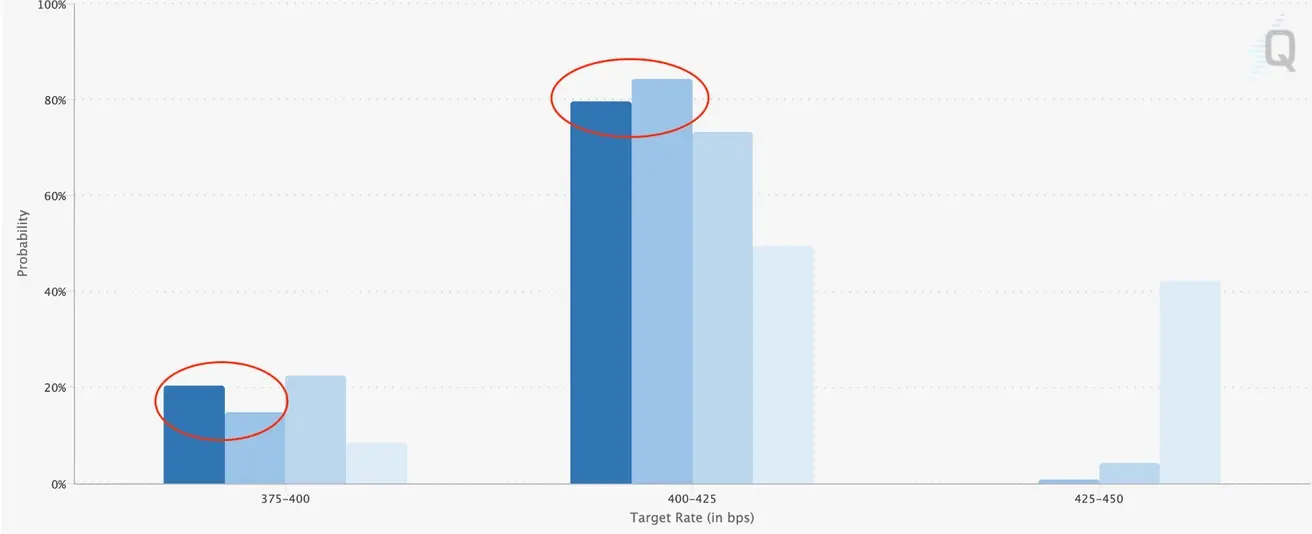
According to CME FedWatch, the market-implied probability of a hold at the next meeting rose from 15.5% to 20.5%, while the probability of a hike fell from 84.5% to 79.5%, though these expectations still prevail:
Treasury yields declined:
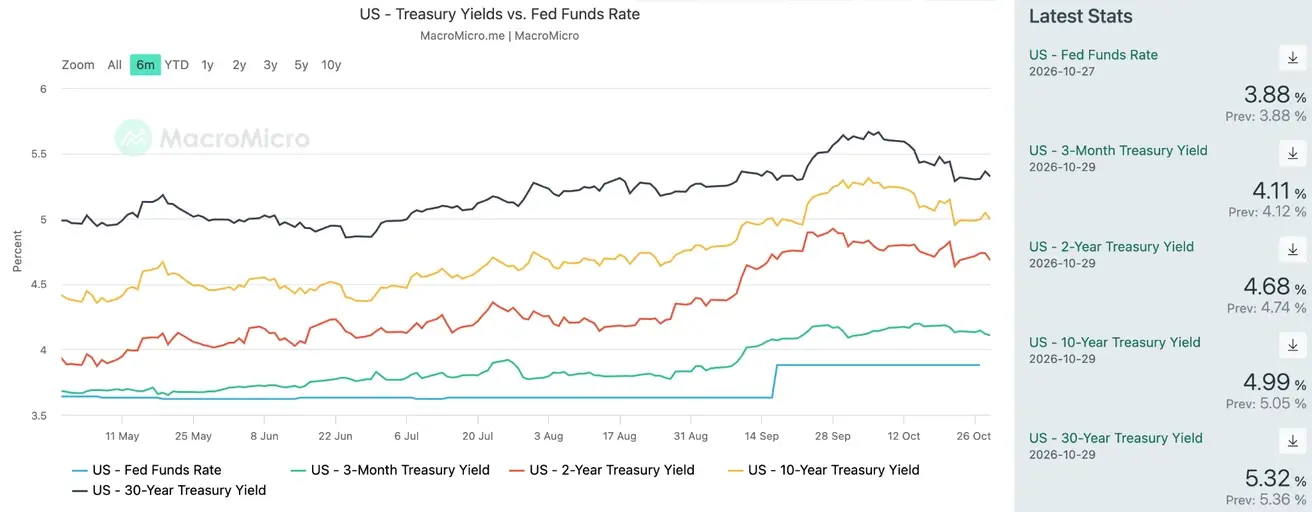
The decline in Treasury yields after the meeting aligns with a moderate softening in FedWatch expectations for the Fed’s future policy.
Indices — a slight decline:
- S&P500: -0.20%;
- Nasdaq 100: -0.78%;
- VIX: +0.86%.