 Русский
 Қазақша
 Eesti
EestiPhysical AI: the next technology frontier
From chatbots to factories and production systems
We continue to follow the development of physical AI — one of the most discussed directions in the technology world right now. Prometheus, Jeff Bezos's ambitious venture that the entire venture world is talking about, deserves particular attention in this space. We break down how physical AI differs from the generative AI we know, and why Prometheus is positioning itself as a leader in this emerging market.
What is physical AI
When ChatGPT launched in 2022, the world got its first mass introduction to generative AI — a technology that writes texts, generates images, writes code, and holds meaningful conversations. Since then, trillions of dollars have poured into this market, and companies like OpenAI, Anthropic, and Google have become symbols of a new technological era. But while the world was watching generative AI, the next frontier was quietly taking shape.
Physical AI refers to systems that interact with the real world. Not with text or pixels, but with machines, sensors, and industrial processes. If generative AI taught computers to think, physical AI is teaching them to act.
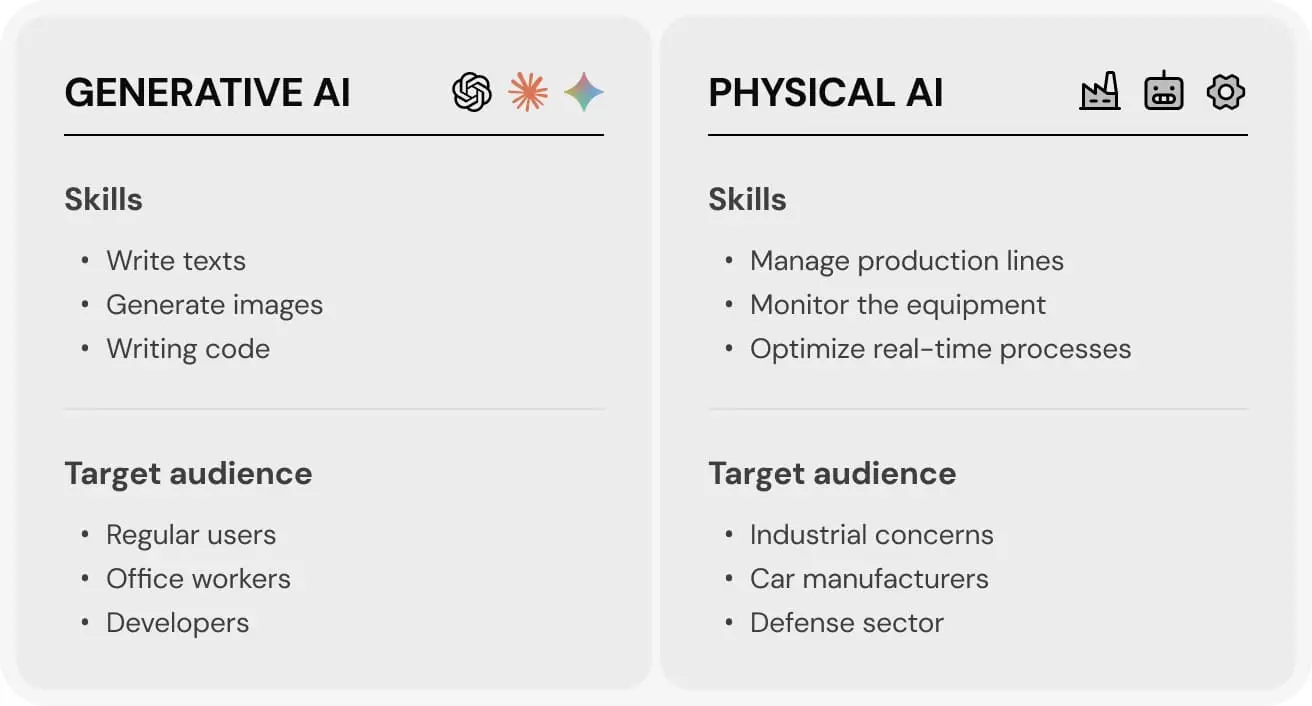
Illustration: Generative AI vs Physical AI
The customers of these systems are not office workers but industrial giants: car manufacturers like BMW, Foxconn, and Stellantis. This is a fundamentally different market, with different economics and different logic.
Why physical AI is harder than generative AI
The key distinction comes down to data. When OpenAI trained its models, a significant share of the required data was publicly available: the internet, books, articles, and other open sources.
Physical AI is a different story. Training a system to manage a production facility requires data from real enterprises: sensor readings, camera footage, equipment parameters, and other details about manufacturing processes. This information is commercially sensitive and largely inaccessible to outside developers. Factories do not share their data: there are no common collection standards, no incentives to open up processes, and installing additional equipment often disrupts production cycles.
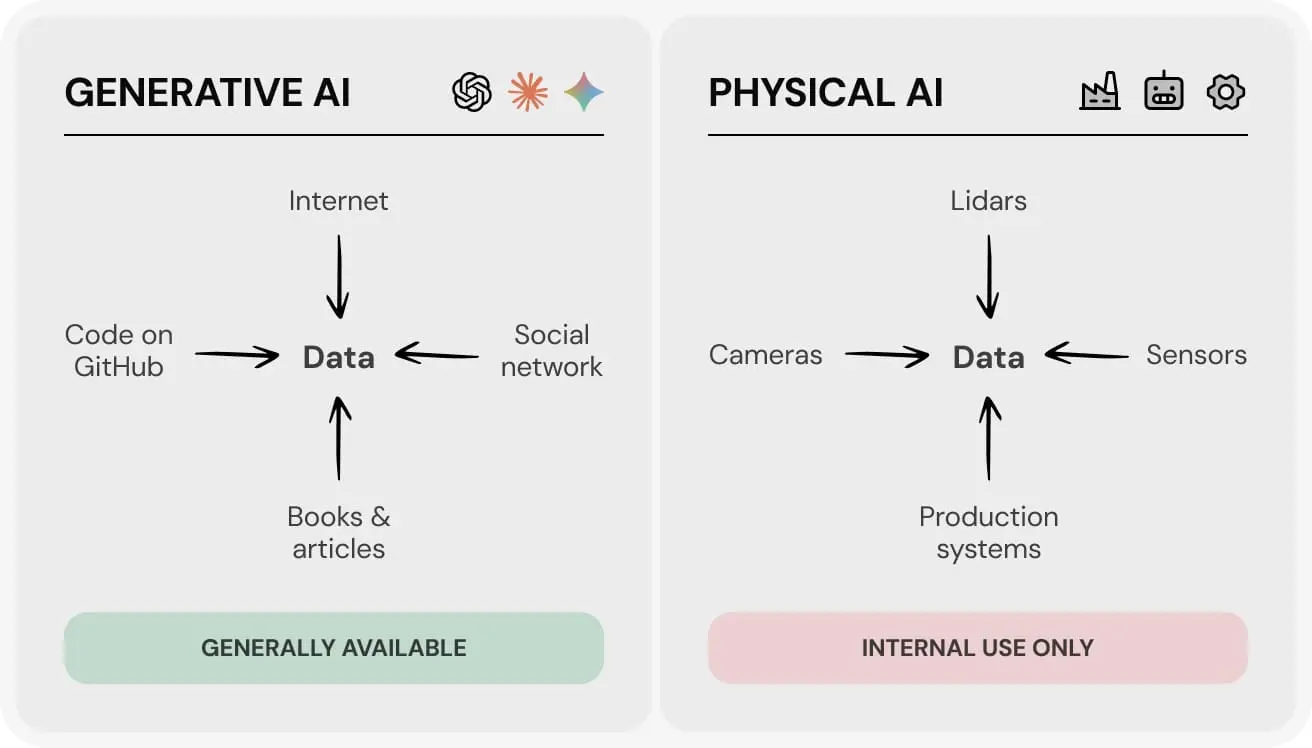
Illustration: Where the data comes from
As a result, physical AI is trained almost entirely on simulations — virtual models of real-world processes. Simulations never fully replace reality: they cannot account for every unexpected event that occurs on a live production floor. Physical AI is expected to be far more reliable and precise from the outset, while having access to far less data to improve on than its generative counterpart.
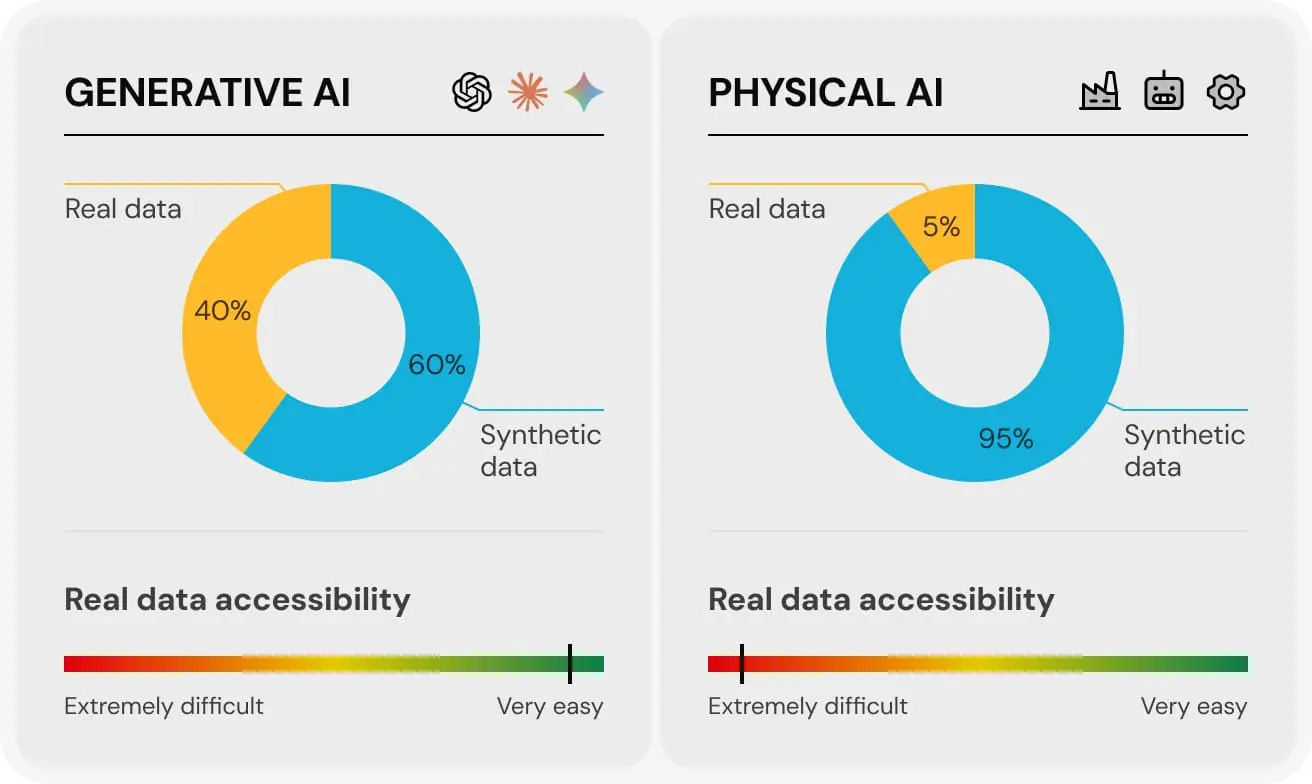
Illustration: Share of real and synthetic data
The cost of a mistake
The difference between the two types of AI becomes most apparent when something goes wrong. If a generative AI produces a poor image, the user simply tries again. If a physical AI makes an error in managing a production line, it can result in a worker being injured, a line shutdown, and multimillion-dollar losses. This is why the reliability and safety requirements for such systems are fundamentally higher, and why development and deployment cycles take years rather than months.
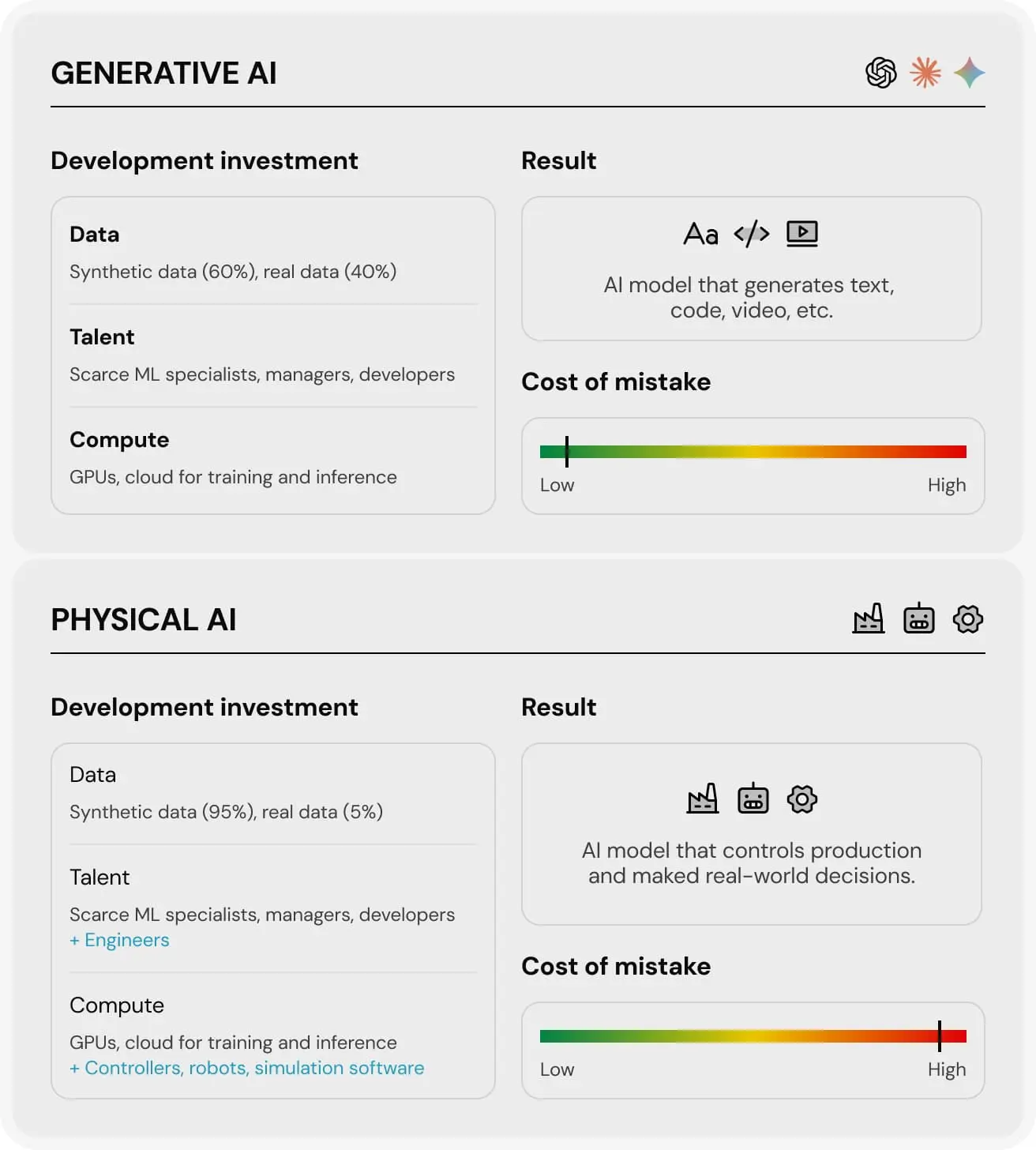
Illustration: Inputs and risks compared
Why now
Despite the high barriers to entry, interest in physical AI is growing rapidly. Companies in this category are valued at a fraction of the established players in generative AI. Figure is valued at $39 billion, and Physical Intelligence is valued at $11 billion. For comparison, OpenAI is valued at $850 billion and Anthropic at approximately $950 billion.
Those who enter the physical AI market now will be where early OpenAI investors were in 2020.
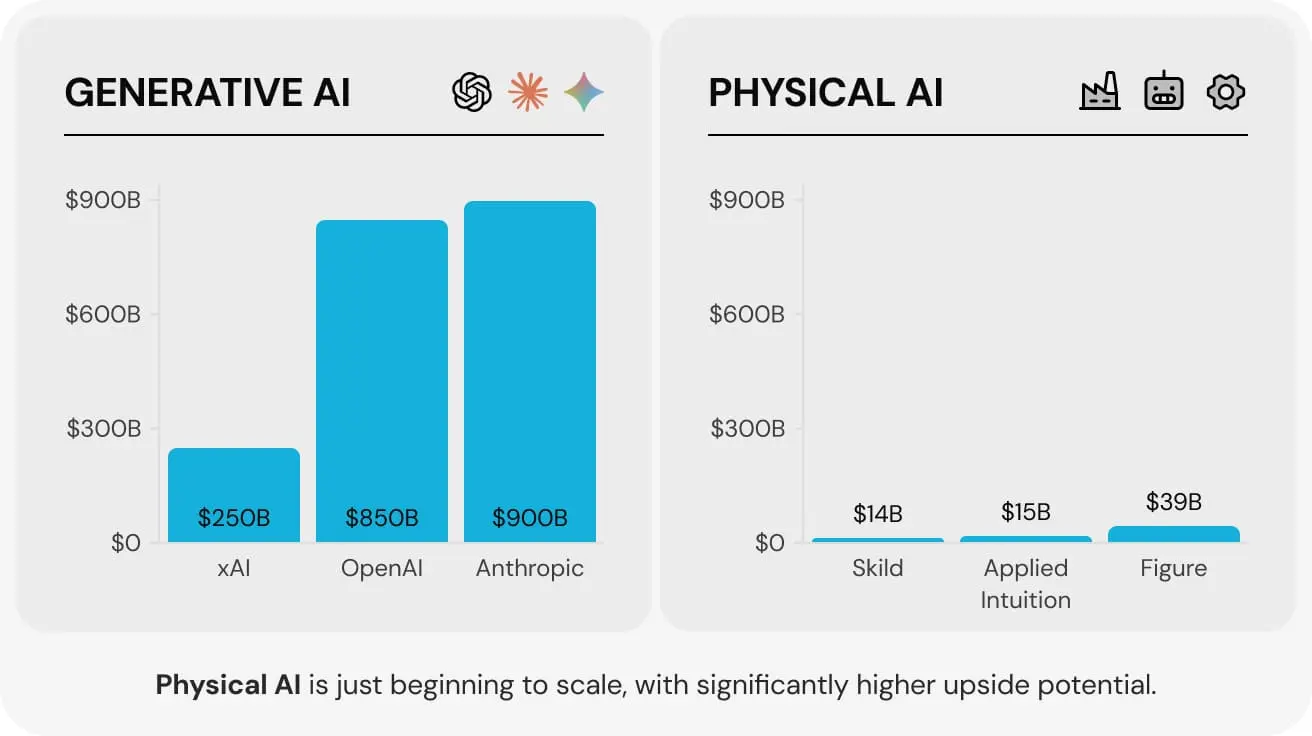
Illustration: Comparing company valuations
How Prometheus is solving the industry's core problem
Every company in the physical AI category runs into the same wall: data from real production facilities is unavailable, so systems are trained on simulations and end up performing below their potential. While every competitor faces this constraint, Prometheus is building a fundamentally different model.
The company plans to spend up to $100 billion acquiring factories and production facilities, and collect data directly from within them. No competitor can replicate this strategy quickly — it requires years and hundreds of billions of dollars. And by the time Prometheus's models are ready for commercial deployment, the company will already have dozens of facilities with proven results — the most convincing marketing possible for industrial clients.
Want to learn more about technology trends and opportunities in new markets? Please contact our expert — we would be happy to answer your questions.