 Русский
 Қазақша
 Eesti
Anthropic Announced the IPO Price and Size
Analyzing the second amendment to S-1 and market conditions ahead of the offering
On November 10, Anthropic filed a second amendment to Form S-1 ahead of the start of investor meetings. In it, the company disclosed the price range, offering size, strategic partner lineup, and revenue data as of the end of October.
The other metrics remained unchanged. We analyzed Anthropic’s finances in the previous article, and covered the mechanics of the offering and lockup in the first piece in the series. Let us take a closer look at the company’s final profile before going public and at market conditions.
New models ahead of the amendment
A day before filing the second amendment, Anthropic released Claude Fable 5.2 and Claude Mythos 5.2. These are two versions of the company’s strongest model, according to Anthropic. Fable 5.2 is available to all users. Mythos 5.2 has fewer restrictions, so only verified organizations get access to it. The new versions respond up to 30% faster than the previous ones and cost 20% less.
The release of new models signals the company’s stability in a volatile market. Media outlets link it to the company’s upcoming IPO.
Offering terms
As part of the IPO, 825 million Class A shares will be sold. They will trade on Nasdaq under the ticker ANT. 801.4 million shares are being issued by the company itself, while 23.6 million are being sold by existing shareholders. The underwriters may additionally buy another 123.75 million shares from the company.
The price range is $70–78 per share.
At the same time as trading begins, seven of Anthropic’s technology partners will buy non-voting Class N shares worth $26 billion at the offering price: AMD, Broadcom, Google, Micron, Microsoft, NVIDIA, and TSMC. Of that amount, Google will buy $10 billion worth of shares. These shares are not subject to a lockup, so the partners will be able to sell them immediately after the offering.
CNBC calculated that at the top of the range, the IPO would raise up to $64.35 billion before fees. Including the private placement, the deal size reaches $90.4 billion, Forbes writes. Existing shareholders are selling only a small portion of the shares in the IPO, so the company itself will receive most of the proceeds.
How Anthropic’s valuation changed
Anthropic’s valuation changed along with revenue growth and market sentiment. In February 2026, a private round valued the company at $380 billion; by May, the valuation had already reached $965 billion.
In the summer, investors cited a target of up to $2 trillion, but according to the Financial Times, this was based on investors’ own calculations rather than data from Anthropic. By the time the offering began, the target had come down. Today, media estimates vary depending on which shares are included in the calculation.
The company’s valuation at the offering is usually quoted based on a calculation that includes all shares: both issued shares and those the company has committed to issue. This applies to options and special restricted employee shares that become available after certain conditions are met, such as tenure. New shares increase the total share count and reduce each existing holder’s stake. This is called dilution.
At a share price of $74, the midpoint of the range, Anthropic’s fully diluted valuation is about $1.33 trillion. The Wall Street Journal calls this figure the target, and CNN gives the same valuation. At $78, the top of the range, CNBC values the company at $1.405 trillion.
Revenue: October growth
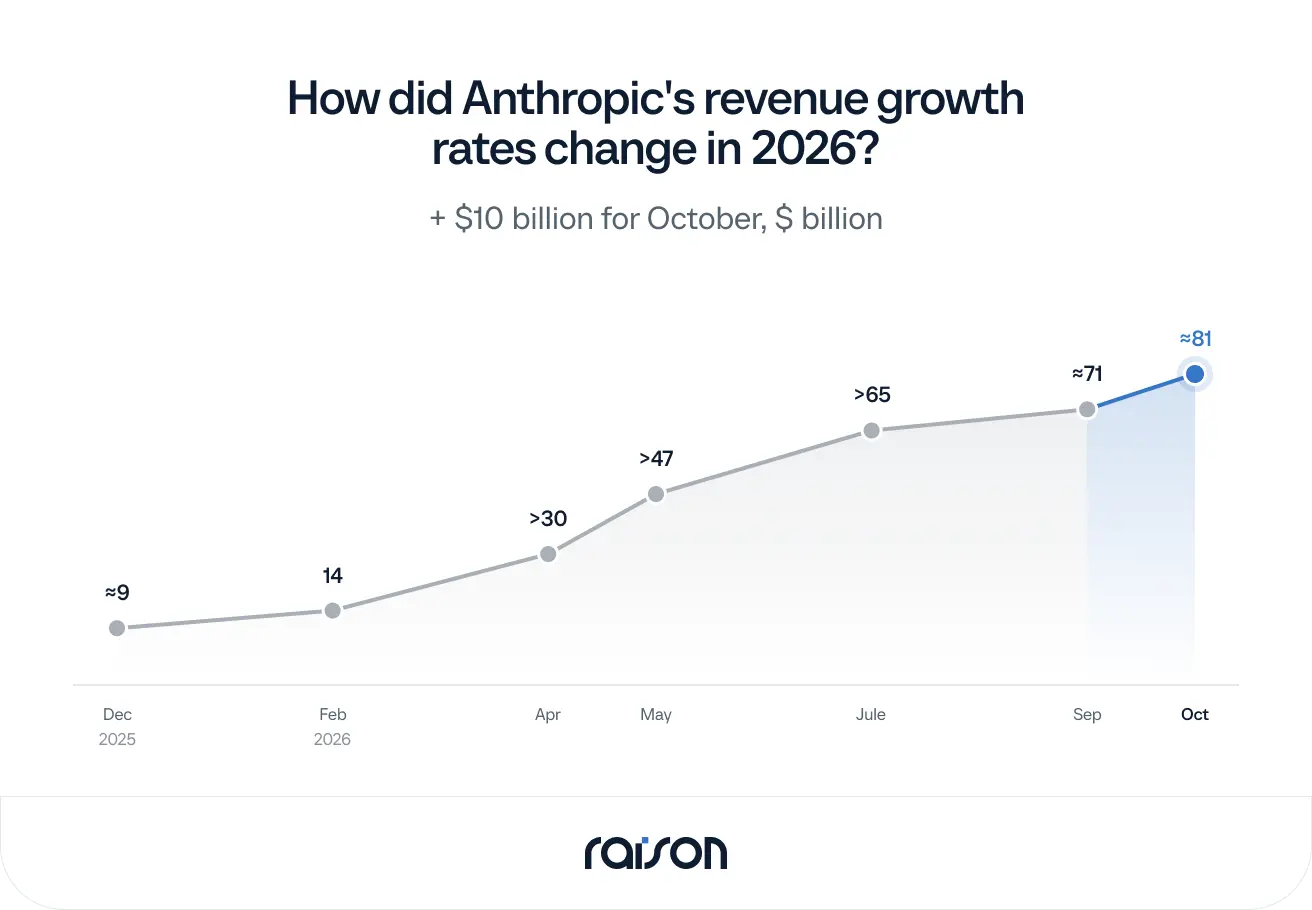
In the second amendment, Anthropic disclosed annual revenue on a run-rate basis as of October 31. It came to about $81 billion. That is $10 billion more than at the end of September.
Growth slowed over the summer. At the end of July, the figure, according to Reuters, exceeded $65 billion, and at the end of September it stood at about $71 billion. In October, it rose by another $10 billion. One month is still not enough to speak of a sustained trend.
In the quarter of the offering, Anthropic will record $14.2 billion in stock-based compensation expenses on a one-time basis. These are restricted stock units (RSUs): employees receive them after meeting two conditions. They have already met the tenure condition; the second condition is the IPO itself.
The company will allocate another $3.5 billion over roughly 3.8 years. These are non-cash expenses. They will reduce reported profit, while no cash will leave the company.
Risks and obligations
Three new items important for risk assessment appeared in the prospectus.
The first is related to the Responsible Scaling Policy. This is Anthropic’s internal policy tied to model capabilities and mandatory safety measures. The company said that, based on expectations for future models, it has reached the threshold for accelerating AI research.
The second item concerns regulation. The U.S. Federal Trade Commission has begun nonpublic reviews of the risks posed by autonomous AI systems, and Anthropic received a request for information.
The third is financial. Anthropic’s obligations under its contract with Microsoft have been expanded to $47.2–49.2 billion for the period from November 2026 through June 2033.
The market ahead of the offering
Anthropic is preparing to go public on Nasdaq amid high volatility in the technology sector. On November 5, after the U.S. midterm elections, the Nasdaq Composite index fell by 5.5%. Sequoia Financial estimates the day’s losses at $2.5 trillion in market capitalization and calls them the largest one-day drop in dollar terms in history. Some investors voiced concerns that the election results could slow the construction of data centers on which AI companies depend.
The market decline affected the deal’s parameters. Quartz reports that a week earlier, investors had expected the company to be valued at around $1.5 trillion. After that, several major shareholders pushed for a lower valuation target. CNBC sources say that institutional investor orders already cover the offering size across the full price range.
On November 9, market attention shifted to NVIDIA. The company’s board began an investigation into the case of CEO Jensen Huang, who may have become the target of a foreign intelligence operation. Market experts note that this story could intensify concerns about an AI “bubble.” NVIDIA is among the partners participating in Anthropic’s private placement.
Conclusion
Anthropic is going public amid rapid revenue growth and large obligations. As of October 31, annual revenue on a run-rate basis reached about $81 billion.
Alongside revenue, spending on computing capacity is also rising: long-term commitments for computing infrastructure amount to about $895 billion, of which about $447.5 billion is due by the end of 2030.
At the top of the price range, the company’s fully diluted valuation is $1.405 trillion.
The main thing left is the final price. It will be set 1 day before trading begins.
If you are considering investing in AI companies before they go public, leave a request in our Telegram bot, and the Raison team will answer all your questions.