 Русский
 Қазақша
 Eesti
Anthropic IPO: What the S-1 Reveals
How the listing works and how existing shareholders will exit
On October 26, Anthropic published its S-1 registration statement and officially disclosed for the first time how the listing would proceed. Until then, the information had remained confidential, and the market had relied only on leaks and media estimates. Once the document becomes effective, the company will be legally liable to investors for its contents.
Some data are still missing from the prospectus: the price range, the number of shares to be offered, and revenue for Q3 2026. These will appear in amendments to the prospectus before investor meetings begin.
In this article, we will explain what an S-1 is, how the offering will work, what will happen to the shares already issued, and how the company is preparing for the start of trading.
What is an S-1
Before listing on a U.S. exchange, a company must disclose detailed information about its business to investors. To do this, it files an S-1 registration statement with the U.S. Securities and Exchange Commission (SEC), which regulates the country’s stock market.
Under SEC rules, the S-1 describes the company’s business, financial condition, key risks, and management, and includes financial statements audited by an independent auditor. For Anthropic, this document runs to more than 300 pages.
Initially, a company may submit a draft S-1 to the SEC confidentially, as Claude’s developer did. It must then file the registration statement publicly together with the confidential drafts no later than 15 days before the requested effective date. Anthropic has already completed both stages and will continue to update the prospectus with amendments before the offering.
The final version with the offering price will appear after investor meetings, and the company will be able to sell shares only after the SEC declares the document effective.
How the offering will be structured
Anthropic has filed to list shares on Nasdaq under the ticker ANT. The company chose the Global Select Market segment, for which the exchange sets the strictest requirements for financial metrics, market capitalization, and liquidity. Only Class A shares will trade on the exchange.
Each Class A share carries one vote at shareholders’ meetings. The co-founders hold 50.1% of all votes, through the single Class F share issued to the company they created. All other voting shares, including Class A, account for 49.9%.
Goldman Sachs and Morgan Stanley are serving as lead underwriters. In total, 22 banks are participating, including J.P. Morgan, Citigroup, Barclays, and Bank of America.
The shares will be sold both by Anthropic itself and by its existing shareholders, including the seven co-founders. The company will receive proceeds only from the sale of new shares. Part of the funds raised will go toward expanding computing capacity and infrastructure.
What will happen to existing shareholders’ shares
Before the IPO, preferred shares that funds and strategic partners received in financing rounds will be converted into Class A common shares or Class N shares, depending on the series.
The economic rights of both classes are the same. Class A shares carry voting rights and will trade on the exchange. Class N shares are mainly held by the company’s strategic partners and do not carry voting rights. If sold to a third-party buyer, they are generally converted into Class A shares. After the lockup period ends, shareholders will be able to sell the shares on the exchange.
The same rules apply to shares purchased on the secondary market. If they were acquired through a fund, the fund itself remains the shareholder of record, and the exit terms for its participants are determined by the fund documents.
Another share class, Class T, belongs to the independent Long-Term Benefit Trust. A Class T share allows the trust to elect a majority of the board of directors and does not entitle it to dividends.
On September 17, 2026, Anthropic carried out a stock split. Class A and Class N shares were split at a ratio of 10-for-1: each share became ten shares, while shareholders’ ownership stakes in the company remained unchanged. On the same day, the company carried out a reverse split of Class T shares at a ratio of 1-for-1000, and there is now one such share.
Lockup: phased release
After the IPO, Anthropic’s existing shareholders will not be able to sell shares immediately. In the market, a single lockup usually applies: for 180 days after the offering, shareholders do not sell shares, and then restrictions are lifted for everyone at once. At Anthropic, the restrictions are lifted in stages, and each shareholder group has its own schedule.
A phased schedule reduces the risk that a large volume of shares will hit the market all at once after the lockup ends and put pressure on the price. This is especially important for Anthropic, as the company’s early investors hold large stakes. Shares are released in small increments, and most stages are tied to the publication of results for 2026 and the first three quarters of 2027. New tranches become available for sale after the market sees the company’s latest results.
The prospectus identifies four shareholder groups:
- Management, excluding the co-founders, and some employees. They will start selling first: the first tranche on the first trading day, the second after the 2026 results. The restrictions will be fully lifted after the Q1 2027 results or on day 180.
- The “180-day” group. This includes the remaining shareholders. They will be able to sell shares in small tranches starting on day 27 after the prospectus date. The restrictions will be fully lifted on the same schedule as for management.
- The “365-day” group. Shareholders with more than 0.5% of the company. They have the longest schedule, and each stage releases only a small portion of the stake. The restrictions will be fully lifted after the Q3 2027 results or on day 365.
- The co-founders. They will not be able to sell shares until the Q1 2027 results or day 180. After that, 29% of the stake will become available to them, and the rest after the Q3 2027 results or on day 365.
The lead underwriters may waive the restrictions early, in whole or in part.
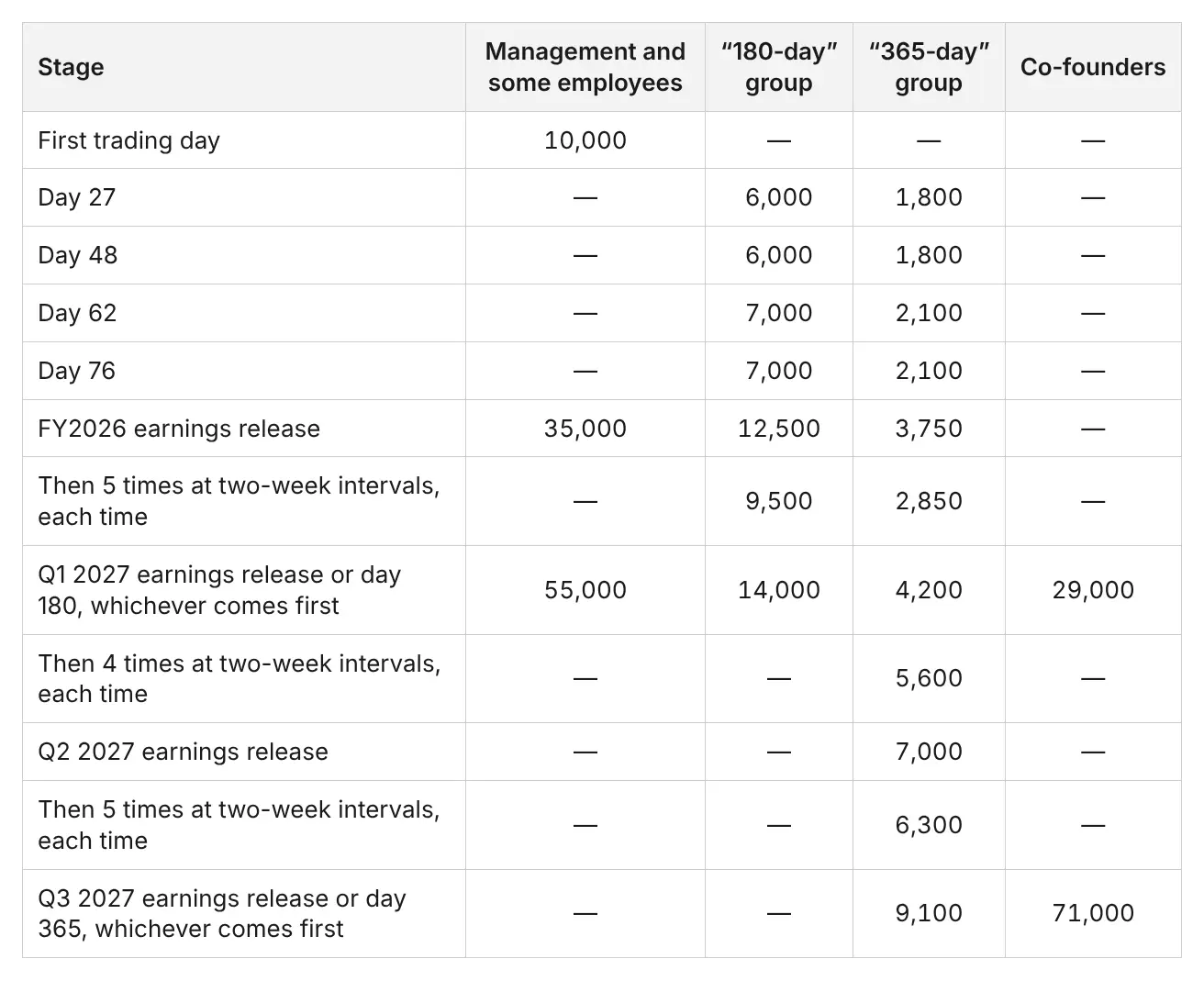
The table below shows the phased lockup release schedule, presented using a 100,000-share stake as an example. The figures in the table are directly tied to the percentages stated in the prospectus: 1,000 shares correspond to 1% of the stake, and 6,000 shares correspond to 6%. The cells show how many shares from such a stake may be sold additionally at each stage.
All percentages are calculated based on each individual shareholder’s stake. For example, 10% for management means one-tenth of the shares held by a specific executive. The prospectus does not yet disclose what portion of Anthropic’s capital belongs to each group.
The days are counted from the date of the final prospectus, when the offering price will be announced. Of the two conditions in each row, the one that comes first applies.
It is important to note that the lifting of restrictions only gives shareholders the right to sell shares. Each of them decides whether to exercise that right and to what extent, so it is not possible in advance to say whether the lockup stages will put pressure on the price, or how strong that pressure may be.
Over a longer horizon, the share price will be driven primarily by the company’s financial results and market expectations for its growth.
Investor meetings before trading
Before the IPO, Anthropic will add a price range to the prospectus, and management will hold meetings with funds and other large investors. Based on those meetings, the banks will gauge demand, and the company will set the offering price. The next day, the shares will begin trading on the exchange. At IPOs, most shares are typically allocated to institutional and high-net-worth clients of the banks, while retail investors buy shares later on the exchange.
According to Bloomberg, Anthropic is discussing the possibility of allocating about 15–20% of the offering to retail investors. The company could begin meetings as early as November 9 and hold the IPO before Thanksgiving, which falls on November 26 this year.
How the market reacted to the prospectus
The publication of the preliminary prospectus sparked a wave of discussion, and market participants disagreed. Some investors saw it as confirmation of AI’s commercial potential. Others doubt that the rapid pace of revenue growth will offset the company’s heavy spending and allow it to become profitable over time.
Positive views are tied to the expanding base of corporate clients, rising spending on Anthropic’s products, and the cash cushion on the company’s balance sheet. According to Bloomberg, the prospectus publication renewed interest in AI company shares after two weeks of declines.
The prospectus stirred greed far more than fear.
Max Gokhman
Head of AI and Digital Assets at Franklin Templeton
The doubts stem from the high expected valuation amid losses and from large commitments to purchase computing capacity. Skeptics point out that these costs will pay off only if rapid growth continues. Thomas Hayes of Great Hill Capital believes the expected valuation is too high. Michael Burry warns that if growth stalls, the entire industry will be vulnerable.
The market is also discussing the risks disclosed by the company itself: from slowing growth and large commitments for computing capacity to AI misuse, unpredictable model behavior, and catastrophic consequences of their operation, Axios writes. These warnings went beyond financial analysis.
Conclusion
The publication of the prospectus has shifted the Anthropic debate onto a more concrete footing. The market is now focused on three questions: how large the company’s commercial potential is, what price investors are willing to pay for it, and who will bear the financial and social consequences if the risks materialize.
In the next articles, we will examine Anthropic’s financial metrics and the risks the company identifies, and we will continue to track amendments to the prospectus.
Want to learn how to invest in technology companies before they go public? Leave a request in the Raison bot, and an expert will answer your questions.