 Русский
 Қазақша
 Eesti
EestiAnthropic and OpenAI in Numbers Ahead of IPO
Analysis of the business models, valuations, and finances of two AI leaders
Roman Z., venture analyst at Raison
The history of OpenAI and Anthropic is reminiscent of the film “Ford v Ferrari.” One company makes a cheaper, more mass-market product, while the other wins on quality and costs more, and at different points in the race, first one and then the other pulls ahead. Both are now preparing for IPOs. Anthropic postponed its listing to November, while OpenAI set its sights on 2027. It is the right time to pin down where each stands.
How it all began
OpenAI appeared in 2015 as a nonprofit organization whose goal was to create AGI (Artificial General Intelligence) safely and usefully for all humanity. But AI development requires enormous amounts of money, and donations alone are not enough. Gradually, the company shifted to a commercial model.
In 2021, part of the team led by Dario Amodei, who headed research at OpenAI, left and founded Anthropic. One of the main disagreements was alignment — the task of making AI follow not only the wording of a prompt, but also its meaning.
For example, if you ask a model to hold users’ attention, it may start using clickbait. Formally, the goal is achieved, but not as intended. The more powerful the model, the more serious the consequences of such mistakes, and Anthropic’s founders believed OpenAI paid too little attention to this problem. Since then, safety in development has remained an important part of Anthropic’s identity, although its approach also draws criticism in the industry.
Where the $25 billion revenue gap comes from
Over several years, both companies have grown from research labs into the world’s largest private AI businesses, and the difference between them is best seen in revenue. For comparison, we use ARR (annualized revenue run rate) — revenue for the latest month or quarter, annualized.
The gap is explained by a combination of two factors:
- Anthropic has a stronger presence in the enterprise segment, where the most money is
- Its tokens are more expensive, and its models consume more of them.
Even if both companies’ systems were used to solve the same tasks in the same volume, Anthropic would earn more from them. Token pricing and consumption are compared by Artificial Analysis.
Valuation and multiples
To compare valuations, we use the P/S (price-to-sales) multiple. It shows how many times a company’s valuation exceeds its annual revenue. It is usually calculated using actual revenue, but Anthropic and OpenAI do not publish financial statements, so we use ARR.
There is a nuance to this approach. Both companies are growing quickly, so ARR is higher than their average revenue over the past year, and the multiple comes out lower, making the companies look slightly cheaper. But for Anthropic and OpenAI, this is an acceptable approximation. A significant share of revenue comes from auto-renewing subscriptions and API usage, where consumption usually grows, so the current run rate is stable enough to use as a proxy for future annual revenue.
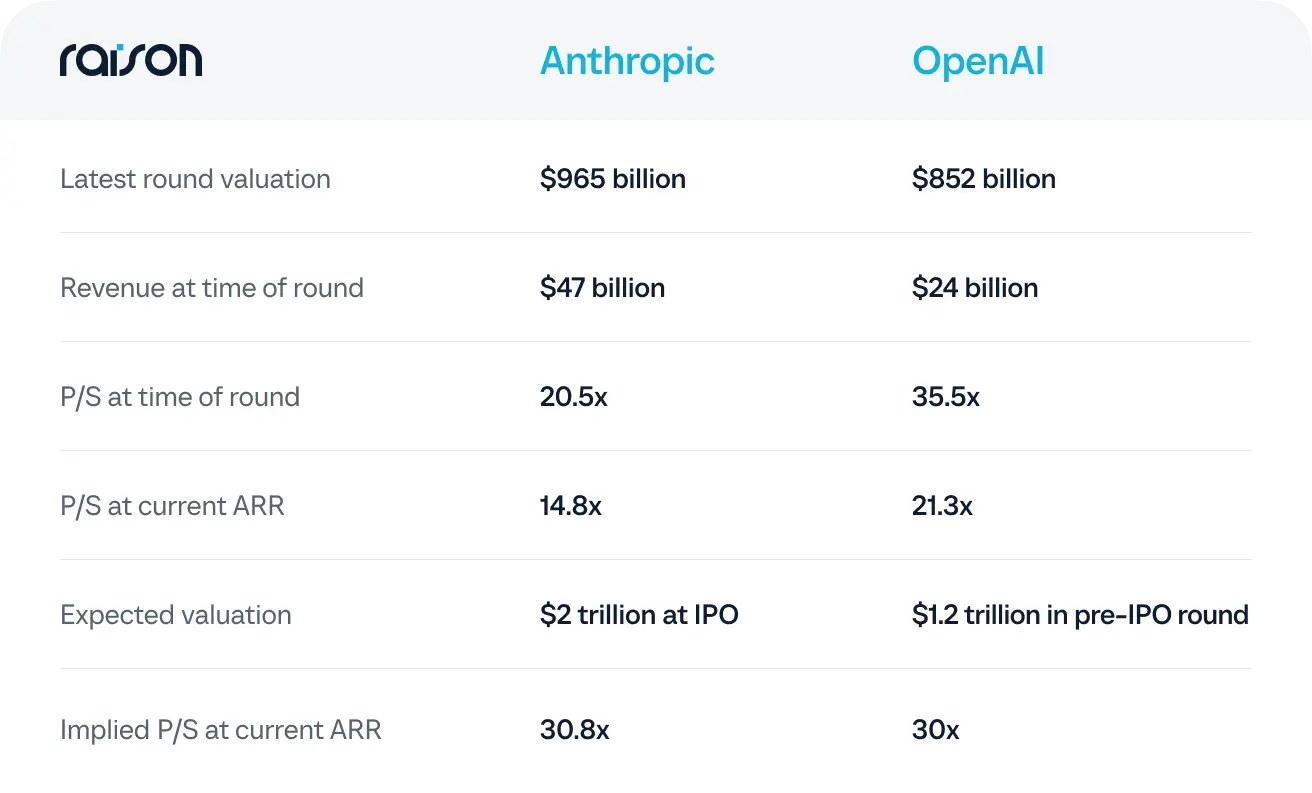
At the time of the latest funding rounds, OpenAI was valued at a noticeable premium to Anthropic, meaning it was more expensive on a per-dollar-of-revenue basis, even though it showed more modest results. This premium is largely historical: OpenAI was first to market with neural networks and had already accumulated a significant portion of its valuation before Anthropic began growing faster.
The expected valuations discussed by FT bring the picture into alignment. The market values both companies at roughly 30 times annual revenue, and OpenAI’s historical premium disappears. In addition, by the time of the IPO and the new funding round, both will have increased ARR, and the multiples will compress.
For comparison, the multiples of major technology IPOs in past years:
- Facebook — about 26x on ARR
- Amazon — about 27.8x on revenue for the 12 months before the listing
- Palantir — about 30x
- SpaceX — 103x
The calculation methods behind these benchmarks differ, so the comparison is approximate. But it confirms the conclusion: in absolute terms, Anthropic and OpenAI will become among the most expensive companies ever to go public, while on multiples there is nothing anomalous in these figures.
Revenue structure
The companies earn from different clients:
- Anthropic — about 80% of revenue comes from API, another $2.5 billion comes from Claude Code, and subscriptions account for about 20%.
- OpenAI — 26% of revenue comes from API and 16% from Enterprise-level corporate subscriptions, meaning only 42% can confidently be classified as enterprise-related.
Some of OpenAI’s regular subscriptions are also used for work, but even with that adjustment, the business brings the company significantly less money. Anthropic has targeted enterprise clients from the start, and in many ways it benefits from Claude’s availability on AWS — Amazon’s cloud platform and the world’s largest provider of computing capacity for business. Many companies already keep their infrastructure there, so connecting Claude to it can be done quickly and without unnecessary integrations.
An important caveat: these figures do not show which company has more users. Anthropic charges more for the same volume of tasks, so OpenAI may well lead in the number of clients and tasks solved even in the enterprise segment, simply monetizing it less effectively.
Compute commitments
A precise picture of debt usually has to be assembled piece by piece, since a significant share of infrastructure-related AI debt is currently off balance sheet. Internal financial documents have already leaked for Anthropic and OpenAI, clarifying part of the picture: the first company’s IPO prospectus and the second company’s audited financial statements for 2025. They show the total amount of compute commitments, but not which portion is locked in by contract and which remains only an intention. Public analyst estimates fill in that breakdown.
There are two types of commitments. Some are contractually binding, and payment will be required in any case. Others remain framework agreements that can still be revised:
- Anthropic — $518 billion, of which about 60%, or roughly $310 billion, falls under binding contracts.
- OpenAI — the total reaches $750 billion, and about half of that, or roughly $375 billion, can be considered binding
OpenAI has already revised its plans. First, the company cut them from $1.4 trillion to $600 billion, and then raised them again. On binding contracts, the amounts are comparable for both companies. Historically, OpenAI has had more non-binding commitments, although recently the company has become more restrained.
Overall, Anthropic spends more cautiously on infrastructure. This reduces financial risk, but as we will see later, caution also has a price.
The path to profitability
Anthropic turned operating profitable for the first time in the second quarter of 2026 and told shareholders it expects to repeat the result in the third quarter. For now, this refers to an adjusted figure, and the company does not disclose exact amounts. In the second quarter, revenue was $11.5 billion, three times higher than in 2025.
The leaked IPO prospectus gives a fuller picture for previous years. Anthropic’s operating loss by year:
- 2023 — $2 billion;
- 2024 — $8 billion;
- 2025 — $8 billion, if the net loss of $42 billion is adjusted to remove the $34 billion non-operating revaluation of financial liabilities.
In total, that is about $18 billion over three years. By comparison, according to its own leaked documents, OpenAI’s operating loss for 2025 alone was $20.9 billion on revenue of $13.07 billion, more than Anthropic accumulated over three years.
An important detail is how Anthropic reached these figures. Over 2024–2025, its revenue grew 12-fold, while operating loss barely increased. This means the business is growing faster than its servicing costs, and sooner or later it should turn profitable, which was confirmed in the second quarter of 2026.
The companies also raised different amounts. Anthropic has raised a little over $130 billion, while OpenAI has raised about $190 billion. The larger cushion allows OpenAI to remain unprofitable longer and invest more aggressively in infrastructure.
How the balance of power changed in 2026
Spring 2026 was Anthropic’s best period. Demand for Claude surged, Mythos and Fable were released, and by valuation the company overtook OpenAI and filed for an IPO. But then its own capacity suddenly became insufficient: Anthropic had to cut limits, raise token prices, and rent the Colossus data center from SpaceX — we wrote more about that deal here in our piece on SpaceX’s IPO.
In the summer, cheap Chinese models entered the market, and Kimi rose to third place in the Artificial Analysis rankings. Large companies began distributing tasks across different models to save money, and Claude’s high price became a vulnerability.
OpenAI, meanwhile, benefited from the capacity it had contracted in advance. When demand growth slowed, the company redirected that capacity to training new models and now releases them almost simultaneously with Anthropic, sometimes within hours. In the Intelligence Index from Artificial Analysis, Claude models still slightly outperform competitors, but OpenAI is ahead on task-solving cost.
Conclusions
In the spring, the market believed two ideas. The first said Anthropic had already won the race and its lead was almost impossible to close. The second predicted OpenAI’s imminent collapse. Neither proved true.
Anthropic’s leadership turned out to be less durable than it seemed. It was supported by enterprise clients and high token prices, but that same price became a vulnerability when cheap alternatives appeared, and the shortage of capacity forced the company to limit clients. OpenAI, meanwhile, used its capacity buffer and accelerated model releases.
Anthropic has already moved its IPO from October to November. According to media reports, the company wants to show investors third-quarter results before the listing begins, and the decision was made even before statements by a former Anthropic researcher intensified debate over the pace of AI development. But amid the release race and the uneasy mood around AI, further delays cannot be ruled out.
Claude still has a strong position in the enterprise segment, and Anthropic has smaller losses. But without solving the problem of token cost and consumption efficiency, the company will find it difficult to maintain its advantage.
In films, it is usually clear which hero is right. Here, the line is not so easy to draw — each company has already been both Ford and Ferrari. The race is not over yet, and the coming months before the IPO could well change the leader again.