 Русский
 Қазақша
 Eesti
EestiAnthropic: what to know before the IPO
An analyst breakdown of valuation, revenue and risks

We recently wrote about Anthropic's IPO preparations, the record Q2 revenue, and the compute power race with AMD, Meta, and TeraWulf on its side. Rumors and facts around what is likely to be the largest IPO in history are piling up daily, so we figured it was time for an update.
Let's dig into why everyone's comparing this listing to SpaceX's recent IPO, what valuation Anthropic might actually pull off, and what to keep an eye on before the official prospectus lands.
One of the Largest IPOs in History
On June 1, 2026, Anthropic confidentially filed for an IPO, with Morgan Stanley and Goldman Sachs leading the deal as bookrunners. JPMorgan also joined the offering.
Share count and pricing haven't yet been set and, according to Anthropic, will depend on market conditions. The company is aiming to list on Nasdaq in October 2026, with a target valuation of $2T.
For comparison, SpaceX raised $75B on June 12, 2026, currently the largest IPO in history, with its market cap exceeding $2.1T on its first day of trading. If Anthropic's valuation really does land near $2T, this listing will be right up there with the biggest ever, no matter what the final raise ends up being.
Revenue and Growth
Ahead of the IPO, the market is focused on how fast Anthropic's business is actually growing. Let's take a closer look at that trend and see how run-rate stacks up against actual revenue.
In just seven months, Anthropic's run-rate grew from about $9B to more than $65B:
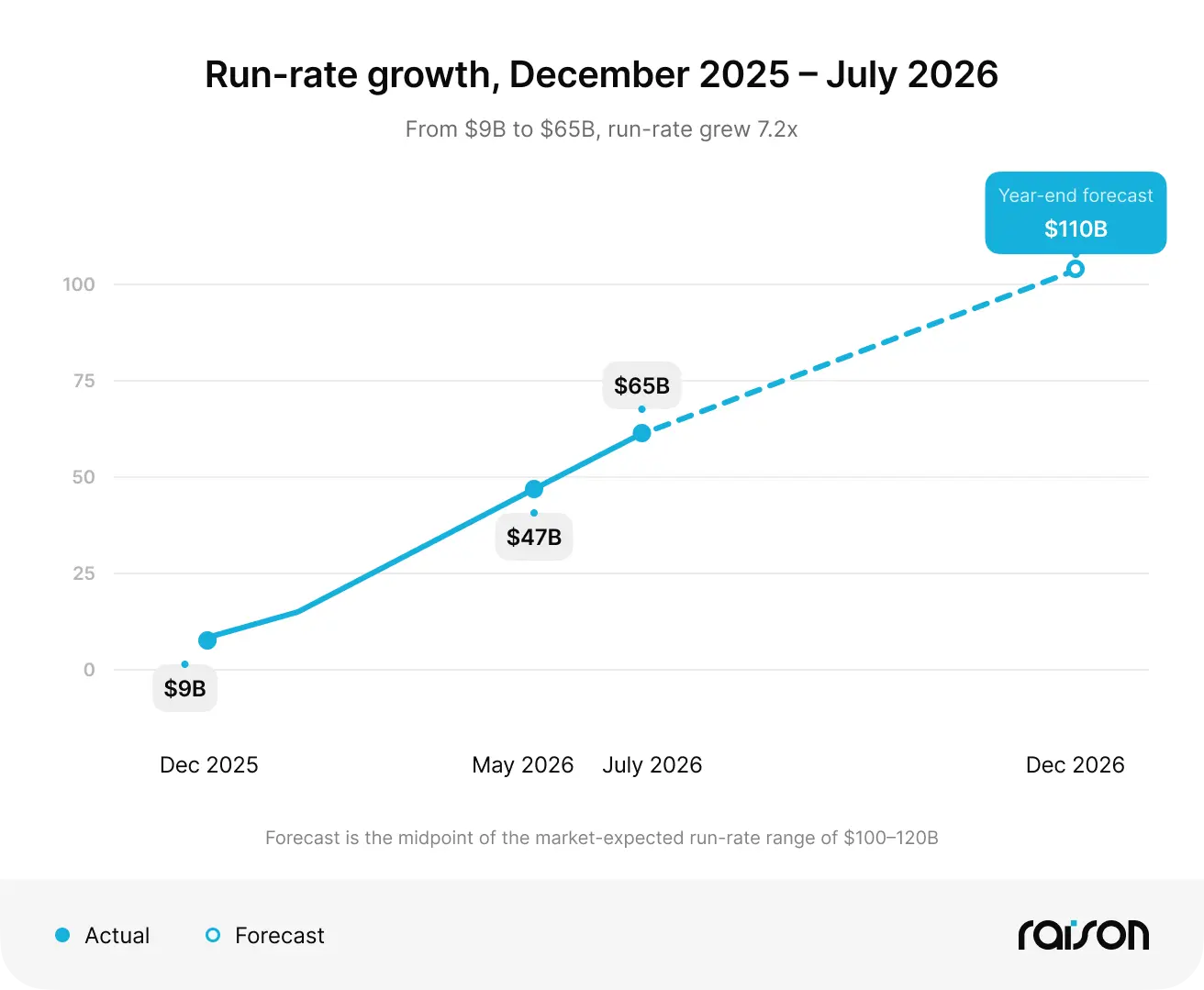
Actual revenue for the first half of 2026 came in at about $16.2B, nearly four times 2025's full-year total of $4.5B. That 2025 figure is an extrapolation, since Anthropic only started disclosing quarterly revenue in 2026 and there's no exact number for the prior year.
Q2 2026 revenue topped $11.5B, up from $4.73B the previous quarter:
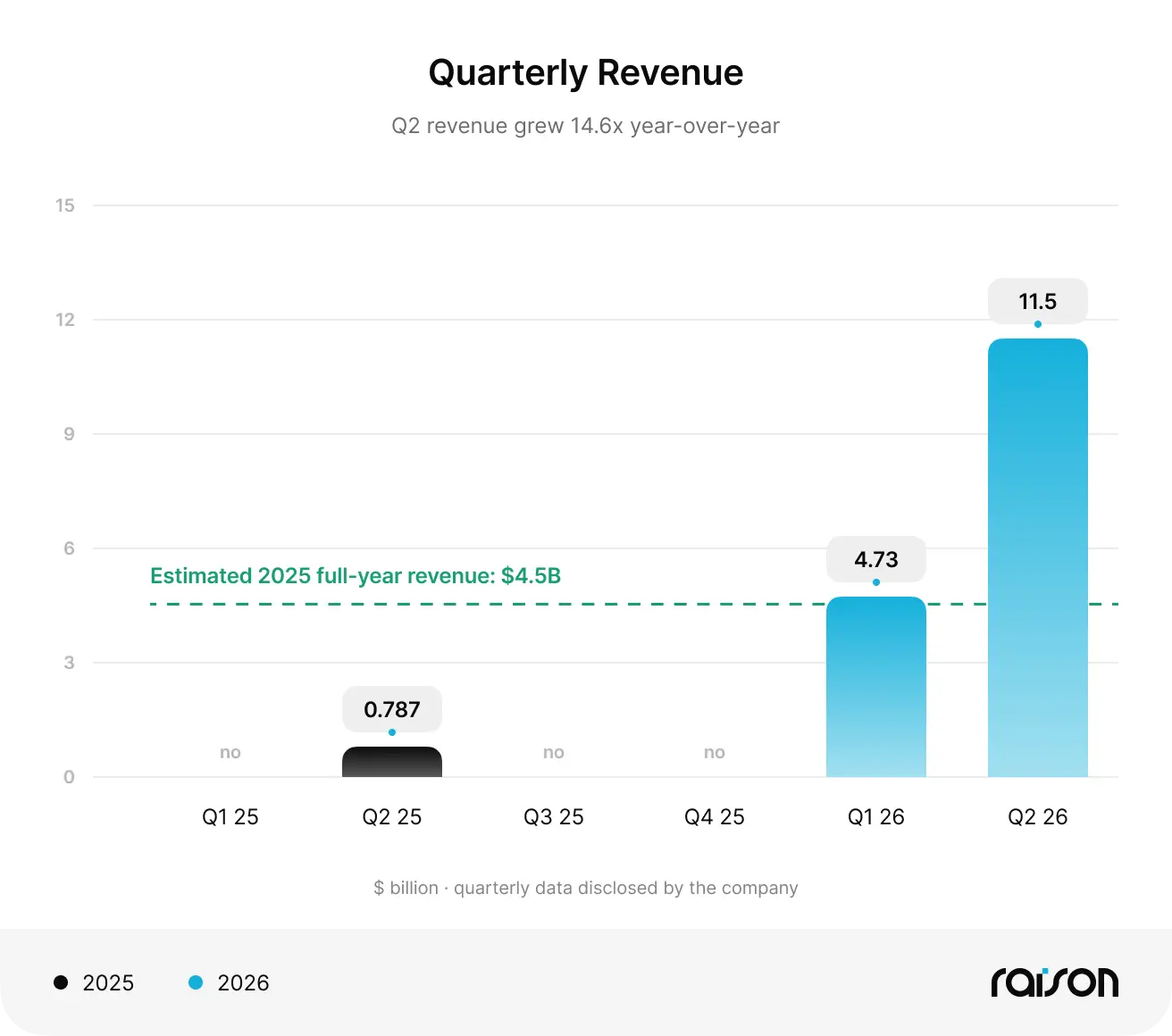
For context, as of July 2026, Anthropic's run-rate had passed $65B, compared to $40B for OpenAI, according to Sacra's estimate. In Q2, Anthropic posted its first-ever positive operating result, while OpenAI stayed in the red.
Sacra also notes that 80% of the company's revenue today comes from more than 300,000 business customers. The number of customers spending $1M or more a year has already topped 1,000, up from more than 500 in February, according to Anthropic.
The Logic Behind Anthropic's Valuation
The last real valuation benchmark was the Series H round: on May 28, 2026, Anthropic raised $65B at a $965B valuation:
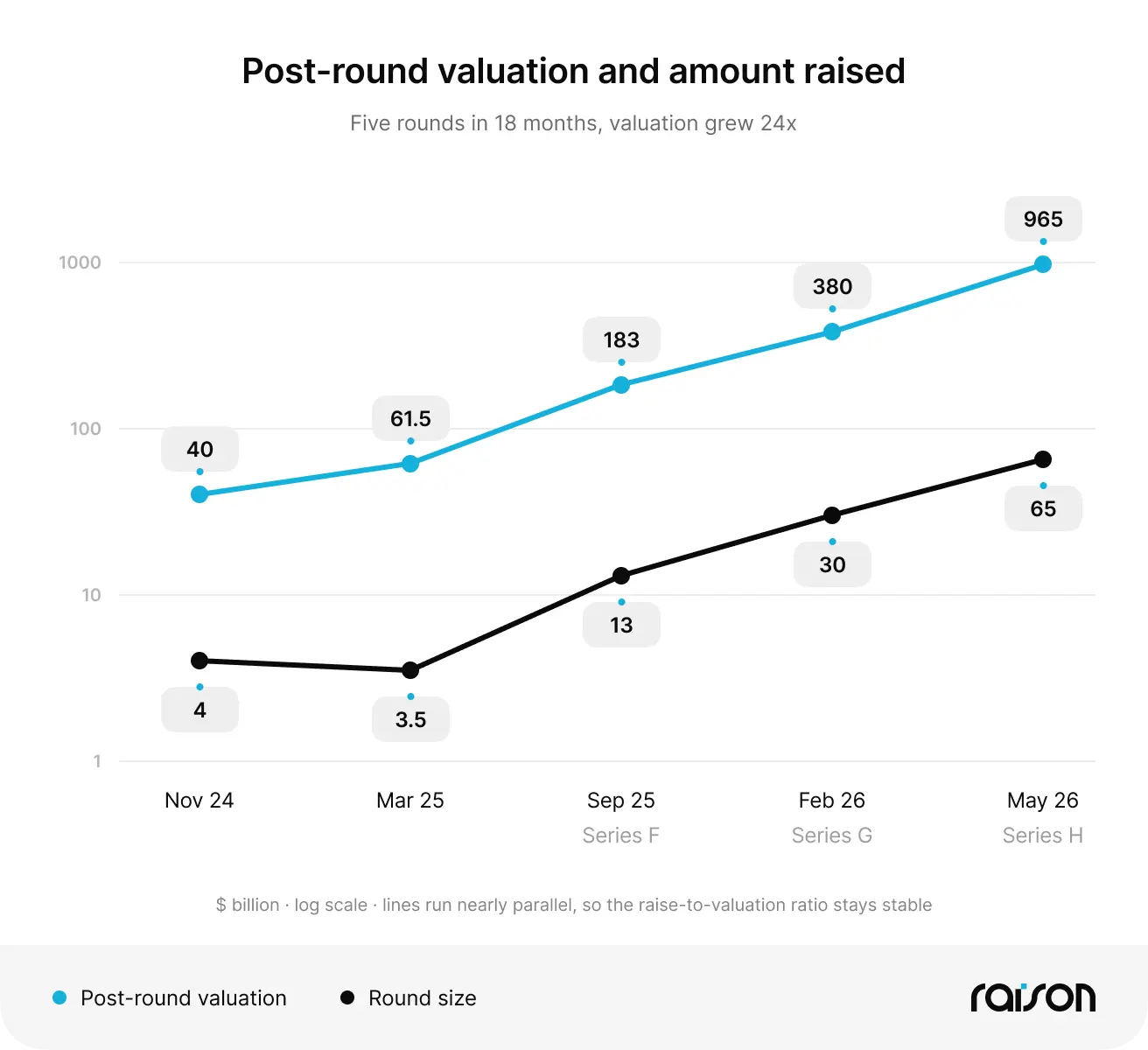
The upcoming IPO's valuation isn't built on current numbers, but on a projected 2028 revenue of $190–200B. That's the load-bearing structure of the deal, and also its major risk. Banks are valuing the company using a forward multiple, a metric that compares the company's value against projected revenue rather than current revenue.
This is standard practice for fast-growing companies. Investors care more about the future scale of the business than current revenue.
What's unusual here is the forecasting horizon itself. A standard forward multiple looks just one year ahead, known as the next twelve months, or NTM. Anthropic's case is different, with banks forecasting two years out instead. That makes sense when the nearest year doesn't really capture the real growth trajectory, while the two-year outlook, backed by contracted volumes, for example, looks a lot more convincing. This is exactly how the AI infrastructure market is being priced right now.
Against the 2028 forecast, $2T comes out to about 10x annual revenue, cheaper than Nvidia trades at right now. On 2026 revenue, that's roughly 33x, lower than Palantir (53x) and Cloudflare (41.6x). There's also a midpoint between the 2028 figure ($2T) and the last round ($965B): this August, the secondary market had the company valued at $1.5T.
It's worth keeping in mind, though, that a two-year forward multiple shifts almost all the execution risk onto the public investor. To hit $200B in 2028 revenue, the company needs to triple its current run-rate in about two and a half years, against compute commitments that are already locked in. If that trajectory slips, multiple compression and a shrinking revenue base would hit at the same time.
There's an argument in Anthropic's favor too. SemiAnalysis points to a structural asymmetry that shows up when comparing the company to its main rival, OpenAI. At equal revenue of $100B, Sam Altman's company would have gross profit roughly $25B lower — the cost of serving a massive free user base, whereas most Claude users pay for a subscription.
The SpaceX Lesson, and What Anthropic Is Missing
The SpaceX case is worth digging into. On June 12, shares were priced at $135, and by the end of that first trading day, the price had already climbed to $161. Market cap topped $2.1T on trading volume of more than 500M shares.
On June 16, the stock hit an intraday high of $225.64. Then came the pullback: by the end of June, shares had settled around $153.
The lockup for existing shareholders runs through December 2026. Only about 4% of shares are in free float. At that low a float, even small trades can move the price noticeably in either direction.
SpaceX's IPO leaned on the most optimistic expectations possible, and a big part of that came down to the Elon Musk effect. His profile alone drives demand from retail investors. But even that didn't stop the stock from taking a sharp hit in its first few months of trading.
Anthropic doesn't have its own Musk, a figure who generates that kind of hype. That means the pricing on its upcoming listing will lean on fundamentals rather than emotional demand.
What We'll Learn After the Listing
Anthropic has warned that any trades in its shares made without direct board approval will be considered invalid. Any offers of indirect participation should be treated the same way — as they directly concern the SPV structures that carry most of the secondary-market volume.
Also, Google, Amazon, Microsoft, and Nvidia are simultaneously investors in Anthropic, its compute suppliers, and its model sales channels. The real scale of their stakes, along with the positions of other institutional holders, will only become visible gradually. After listing, that kind of data is disclosed in quarterly filings, not at the moment of the IPO itself.
Risks Worth Remembering
Conflict with the U.S. Department of Defense
In February 2026, Anthropic was designated a "supply chain risk." Anthropic filed two lawsuits on March 9; on April 8, an appeals court declined to stay the designation.
CFO Krishna Rao stated under oath that the government's actions could cut 2026 revenue by several billion dollars; a $200M contract has already been canceled, with part of it moving to OpenAI. AWS, Google, and Microsoft, meanwhile, have confirmed they will keep selling Claude to commercial customers.
The Unresolved Commerce Department Episode
On June 12, 2026, the U.S. Department of Commerce ordered Anthropic to cut off foreign users, including the company's own employees, from the Fable 5 and Mythos 5 models. The episode was triggered by the report about a vulnerability in Fable 5 that could bypass the models' built-in safeguards, but the restrictions ended up covering Mythos 5 as well. Commerce lifted the export controls on June 30, though it reserved the right to reinstate the requirement.
Compute commitments
The SpaceX contract alone ($15B a year at full run-rate) absorbed roughly half of the annual run-rate at the time it was signed. On top of that come commitments to Azure, AWS, and Google/Broadcom.
Circular financing within the industry
Anthropic's biggest investors are simultaneously its compute suppliers and sales channels for its models. If the hyperscalers revise their capex plans, the effect would cut both ways.
What's Next
The public version of the S-1 hasn't been filed yet. Once that happens, we'll break down its contents separately: share count, price range, and how closely the final terms track, or diverge from, the 2028 revenue forecast the whole valuation rests on.
The Bottom Line
Anthropic is heading into its IPO with strong operating numbers: growing revenue and its first positive operating profit. But the entire target valuation rests on the 2028 forecast.
Investors are floating a $2T target, but that figure shouldn't be taken for granted: the SpaceX precedent shows that even the year's most talked-about IPO isn't immune to a sharp pullback once trading starts, especially with a small float. Even if the listing does price at that level, a drawdown afterward is quite likely.
Anthropic takes a conservative approach to financial matters. That doesn't remove the risk, but it does lower it: the company gives the market fewer reasons for a sharp repricing than a business built around a narrative of expectations rather than actual numbers.
We'll continue to follow Anthropic's IPO preparations and share updates as soon as the public prospectus is released.
Want to learn more about our investment solutions and gain access to exclusive Pre-IPO deals? Please contact our expert to get a personal consultation.