 Русский
 Қазақша
 Eesti
EestiSpaceX: The First Report After the IPO
What the Second Quarter Showed
Recently, we took a detailed look at SpaceX after its IPO: what makes up the company's valuation, why the stock is volatile, and what analysts are watching. With the release of the first quarterly report since the IPO, we decided to update our picture and take a closer look at the company's results.
The report came out strong on momentum but mixed in how the market reads it. Let's break down why the same figures look convincing one moment and worrying the next, and what really lies behind them.
Why the Report Reads Differently
It all depends on what you compare it to.
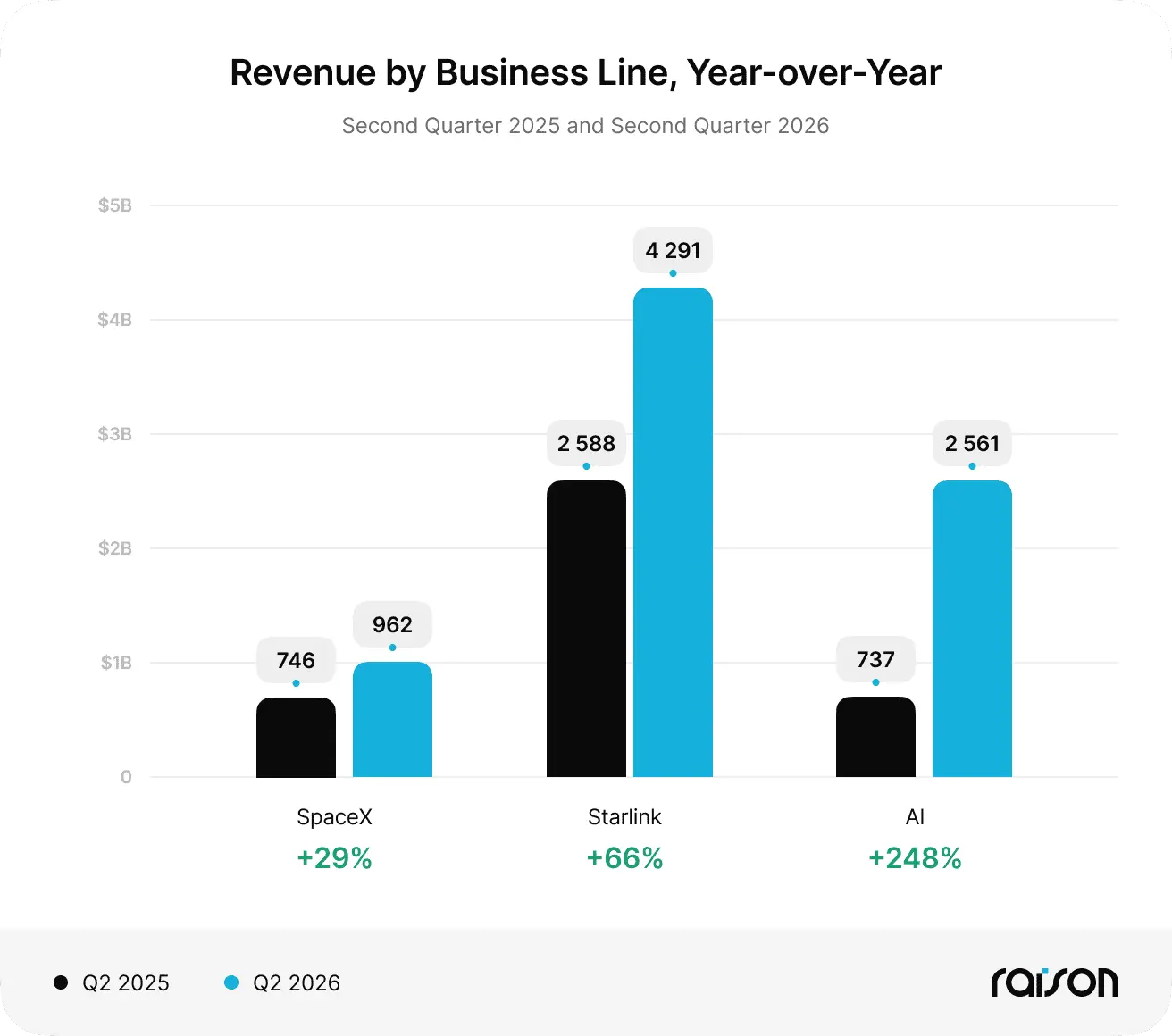
Sequentially, quarter over quarter, the picture is excellent. Total revenue rose 66% versus Q1. The AI division grew by more than 200%, and Starlink grew by about 30%. The quarterly loss, meanwhile, shrank sharply.
Compared to half-year to half-year, though, the result looks weaker. The reason is that the merger of SpaceX and xAI happened in the first quarter of 2026, at the very moment the AI business was at its lowest point and running an almost unbroken streak of losses. That heavy drag is what spoils the half-year picture.
Hence the split in assessments. The company is growing fast and steadily, but some market participants look at the weak half-year figures and draw cautious conclusions. This overlays a broader feature of the stock we wrote about last time: SpaceX went public on high expectations and is still catching up to them more slowly than the market would like.
By the Numbers
For those who like specifics, the key figures for the second quarter:
-
Total revenue rose 66% versus the first quarter of 2026.
-
The AI division grew by more than 200% quarter-over-quarter; Starlink by about 30%.
-
Year-over-year, revenue grew by roughly 53%.
-
The quarterly net loss shrank sharply: from about $4.2B in the first quarter of 2026 to around $541M in the second.
-
The company's cash reserves stand at about $100B.
-
Capital expenditure in the second quarter was around $18B, mostly on AI infrastructure.
-
At the start of the third quarter, new six-month capacity lease contracts worth $6.7B were signed.
For a fast-growing company, absolute figures matter less than the trend right now. That is why what counts is not a one-off loss but how quickly revenue is catching up with capital expenditure.
What Has Changed for the Better
Amid the arguments over how to count the results, it is easy to miss the main point: SpaceX's financial position has strengthened markedly.
After the IPO, the company holds about $100B in cash reserves. That should be enough for two to three years of capital expenditure across two fronts at once: AI and Starship. Part of the funds went to restructuring debt, and the company's debt load fell.
At the same time, Starlink remains the main source of operating profit. Its results almost entirely offset the operating losses of the other two divisions. The business continues to grow steadily, which means Starlink can continue to support SpaceX's large-scale investment in AI.
AI Pays Off With a Delay
The key feature of the report is that the AI division's revenue arrives with a delay relative to its costs. The contracts took effect mid-year, and payments under them come after the services are rendered rather than up front. So only part of the revenue is visible in the reporting so far.
There is a telling example in the report itself. One large client already accounts for about 20% of quarterly revenue, mostly through leasing compute capacity — and that is with its contract having run for only part of the quarter. The report does not name it, but analysts estimate it is Anthropic.
In the third quarter, such deals will run for the full three months, a contract with Google will be added, and likely the revenue of Cursor, which SpaceX is due to acquire for $60B.
Management commented on much of this on the quarterly call with investors. In particular, management said the regulatory questions around the Cursor deal are nearly settled.
In other words, a significant share of already-contracted revenue is still outside the reporting. In the coming quarters, it should be fully reflected in the company's results.
Management's Forecasts and Plans
On the same call with investors, management detailed the company's plans. The tone was optimistic and at times aggressive. The key points:
-
Starlink remains the key source of profit. The corporate and government segments are growing faster than the consumer business; management expects they may surpass it over time.
-
The next driver is Starlink V3. The new generation of satellites should raise network performance roughly tenfold. A noticeable improvement in service is expected once the constellation is deployed, around the second quarter of 2027.
-
Starship is nearing commercial flights. The heat-shield problem, according to management, is largely solved. Next come a higher launch cadence and a shift to more regular flights within about a year.
-
AI is becoming the main source of both growth and costs. By the end of 2026, the company expects more than 2 gigawatts of compute, and by the end of 2027, to approach 10 gigawatts. Management rates demand for capacity as very high: at the start of the third quarter, new six-month contracts worth $6.7B were signed.
-
The forecasts are highly ambitious. By December 2026, the company expects to reach an annual revenue run rate above $100B, and it moved its internal target of $1T in revenue forward from 2031 to 2030.
Here, it is worth keeping in mind a well-known trait of Musk's companies. Management tends to make optimistic forecasts and often shifts timelines, so aggressive targets should be taken with a grain of salt.
Separately, Musk stressed several times that the market underestimates Starlink. Amid the debate over AI and capital expenditure, the satellite business has faded into the background, even though it provides the company with a stable financial base. Starlink is growing fast and is already profitable, so it can cover a significant share of the costs of the other divisions. Meanwhile, its penetration in the airline industry is still around 10%, leaving ample room for further growth.
Musk illustrated the strength of demand with the example of one of the airline clients. According to him, the client shared an unexpected observation:
Customers are flying shorter hop flights instead of direct so that they could ensure that they're on a Starlink-activated flight. They've never seen this in the business before.
Risks Worth Keeping in Mind
The picture should be rounded out with some sober caveats, all the more so because they are the same as before.
-
The Musk-name effect. The “Musk premium,” which we discussed in detail in the previous article, works both ways. A loyal audience backs the company with money and attracts major investors. But Musk's controversial reputation and shifting timelines have also formed a camp of skeptics who press on the stock when results fall short of post-IPO expectations. The PitchBook report shows how well SpaceX delivers on its promises.
-
Supply overhang. There are a great many shareholders, from early investors to recent IPO participants. On top of that, many of them are retail investors, who are prone to impulsive decisions. Even a few active sellers could put a noticeable volume on the market.
-
Capital expenditure (CapEx). This is the figure feared most of all. In the coming quarters, CapEx will likely stay around $18B per quarter, mostly on AI infrastructure.
It is important to understand the broader context: the market has already been through a similar gap between huge investment in AI and delayed returns with the largest technology companies. For SpaceX, this period simply fell in the second and third quarters of 2026. Besides, this is the first public company of its kind in the US, and the market is only just learning how to value it.
What Happened to the Stock After the Report
The stock's movement around the report is a good illustration of how market emotion and real events intersect at SpaceX.
A week before the report, the shares traded at about $110. On the day of publication, the pre-market price reached $125, but shortly after the report was released, it pulled back to $108. There were two reasons:
-
Some impulsive investors exited the stock following the report.
-
The report confirmed the lifting of the first restrictions on share sales, expected on August 6, and the market began preparing in advance for the increase in shares in circulation.
Then sentiment turned. By August 6–7, the price had recovered to $127 amid analyst updates and rising demand for the stock. An extra boost came from a short squeeze — a situation where traders betting on a decline are forced to close their short positions and buy the stock, thereby amplifying the rise. The share of such positions fell from 31% before the report to 11% within two days.
As of August 14, the shares are trading at around $143 in pre-market.
The Bottom Line
The second quarter showed a company that is growing fast and strengthening its foundation, but still falling short of its own high expectations in the areas that are visible without delay. Revenue momentum is strong, the financial cushion is large, Starlink is confidently carrying the economics, and the main return from the AI contracts is still ahead.
The next major event will be the third-quarter report, where AI revenue should be revealed in much greater detail. We will continue to follow SpaceX's progress and share updates.