 Русский
 Қазақша
 Eesti
EestiFOMC Meeting Summary: April 2026
Fed Holds Rates, Signals Rising Uncertainty Ahead
The Federal Open Market Committee (FOMC) held its third meeting of the year, leaving the policy rate unchanged at 3.50%–3.75%, in line with expectations.
Jerome Powell’s remarks at what was his final press conference as Fed Chair signaled a moderate shift toward a more hawkish stance.
Key Takeaways from Powell’s Remarks
The U.S. economy remains relatively resilient. Economic activity continues to expand, consumer spending remains stable, and business investment shows solid momentum. At the same time, the labor market is gradually cooling, while the housing sector remains weak.
The Fed still views tariff effects as largely transitory, unlikely to drive sustained inflation. However, confidence in this assumption has declined. A growing risk factor is the rise in energy prices, which is already feeding into inflation and short-term expectations, even as long-term expectations remain anchored.
The current consensus within the FOMC is that rate hikes are not required at this stage — this remains the position of the majority, including Powell. However, the possibility of tightening is becoming increasingly relevant and, according to Powell, could be actively discussed as early as the next meeting.
We are currently at the upper end of neutral, or possibly moderately restrictive policy. At the same time, the possibility of moving policy in either direction remains, reflecting a high degree of uncertainty.
Jerome Powell
Key Conclusions
The Fed is effectively facing a classic policy dilemma: rising energy prices are simultaneously pushing inflation higher while weighing on economic activity.
On one hand, higher energy costs directly contribute to inflation. On the other hand, they reduce disposable income and constrain consumer demand, increasing the risk of slower growth.
In a broader context, this is not a traditional demand-driven cycle. Instead, the current environment is shaped by external shocks, and their duration and magnitude will determine the path forward — whether inflationary pressures persist or economic growth slows more rapidly.
Under these conditions, any premature rate adjustment risks being a policy mistake. As a result, the Fed’s current approach can be characterized as wait-and-see, with close monitoring of developments in a supply-driven shock environment.
An additional source of uncertainty is the upcoming leadership transition at the Fed. Powell explicitly noted that at the next meeting, the incoming Chair, Kevin Warsh, will play a key role in shaping policy. This suggests that the current cautious stance may be revised depending on his approach to balancing inflation risks and economic growth.
Market Expectations (FedWatch)
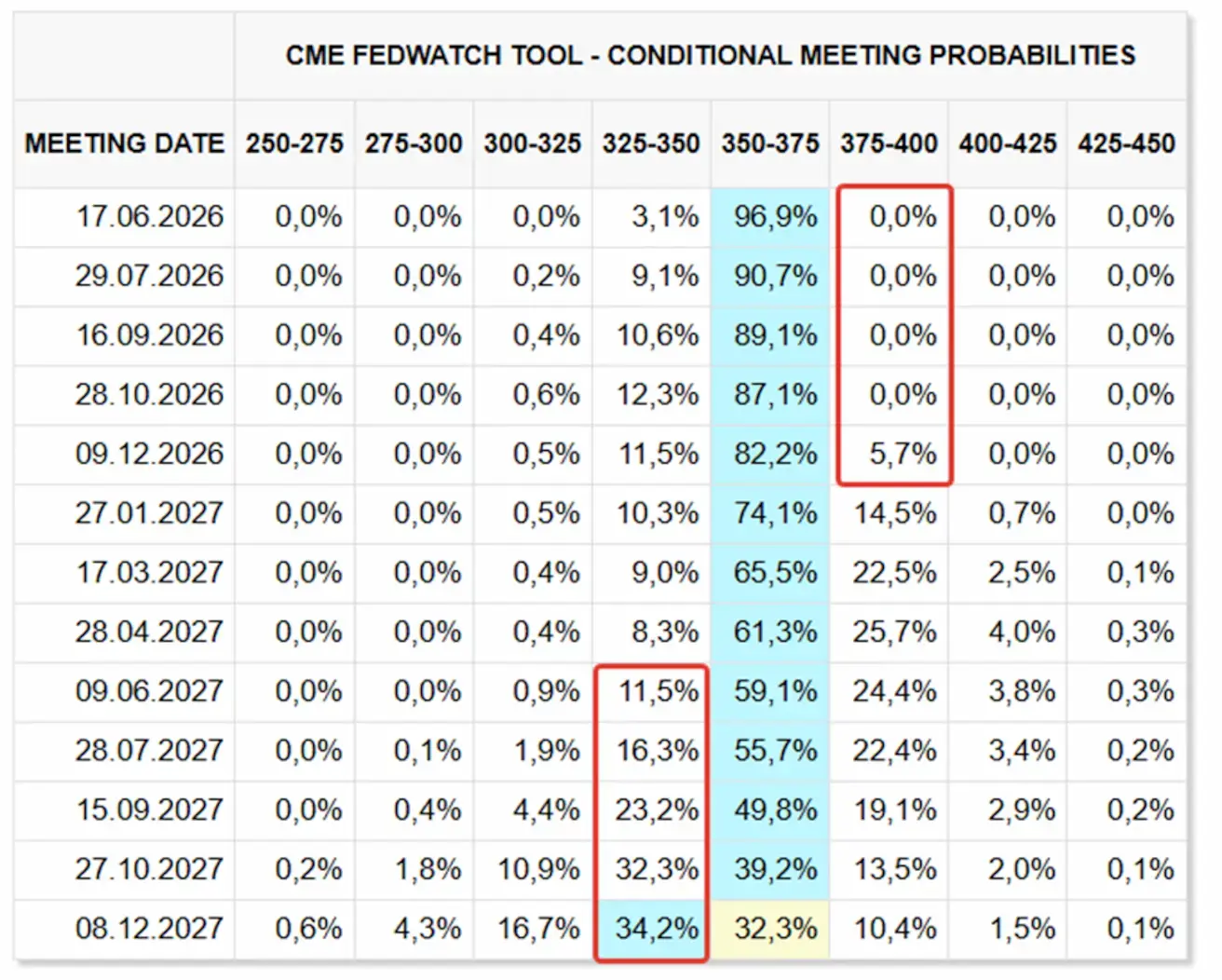
Markets are not pricing in any rate hikes through the end of 2026. Over a longer horizon, starting from the second half of 2027, expectations for a 25 bp rate cut begin to increase.
Market Reaction (Premarket)
- S&P 500 futures: +0.69%
- VIX: −3.97% (17.70)
- Gold futures: +1.89%
- U.S. Dollar Index futures: −0.32%
- ETF TLT (20+ Treasuries): +0.05%
- Bitcoin futures: +0.12%
Why It Matters to Follow FOMC Meetings
The Federal Reserve's decisions directly affect the cost of capital worldwide. Equity and bond valuations, the U.S. dollar exchange rate, investment returns, and risk appetite all depend on them. Even when the rate is left unchanged, the Fed's rhetoric can set the tone for markets for a long time, signaling the prospect of tight policy, a pause, or future easing.