 Русский
 Қазақша
 Eesti
SpaceX posted its first operating profit after the IPO
Revenue for the third quarter increased by 161% year over year
On October 20, one and a half months before the end of the main lockup period (restrictions on share sales for early shareholders), SpaceX published its financial results for the third quarter of 2026 and presented them on a call with investors. Over the year, the company’s revenue increased by 161% to $14.575 billion, and operating profit turned positive for the first time since the IPO, reaching almost $2.8 billion.
We break down the quarter’s key results: where revenue comes from, why operating cash is still insufficient, and how the market reacted to the quarter’s results.
Key figures from the report
Along with revenue, the profitability of the core business also increased. Adjusted EBITDA shows how much the company earns before interest, taxes, depreciation and amortization, as well as a number of non-cash and one-time expenses. Over the year, it increased by 306% to $8.8 billion.
The main growth driver was the Super Intelligence segment (formerly called AI). It includes data centers and cloud capacity, the Grok model, the Cursor developer service, and the X social network. Segment revenue for the quarter amounted to $7.6 billion, and it overtook Starlink for the first time.
Starlink continues to grow and remains the most profitable segment. Segment revenue increased by 69% over the year to $5.2 billion, and operating profit amounted to $2.4 billion out of $2.8 billion for the company as a whole. Starlink’s adjusted EBITDA for the quarter reached $3.5 billion with capital expenditures of $1.5 billion.
Revenue in the space segment rose by 6% over the year to $1.8 billion. Its adjusted EBITDA fell from $674 million to $357 million. The number of launches declined from 44 to 35, and Starship development expenses increased by 44% to $1.2 billion.
In the third quarter, more than half of SpaceX’s revenue came from two customers: 34.5% and 16.6%. The company does not disclose their names. Backlog, that is, the enforceable portion of signed contracts, stood at $63.0 billion at the end of September, and customer prepayments totaled $17.5 billion.
Net profit and cash flow
In the third quarter, SpaceX posted a net profit for the first time since the IPO — $4.4 billion. According to analysts’ estimates, about 40% of this amount came from one-time and temporary factors: interest income on funds raised in the IPO, a revaluation of Elon Musk’s stake in The Boring Company, and a tax benefit. For the first nine months, SpaceX’s net loss amounted to $413 million.
A net profit does not mean the company earns more than it spends. Investments in equipment are reflected in profit gradually: their cost is written off through depreciation over several years. In the third quarter, SpaceX invested $19.6 billion in equipment and infrastructure, and taking these expenses into account, it remains in the red on cash flow for now.
Operating cash is still not enough to cover this: according to TIKR, the gap over nine months was about $35 billion. The company covers it with IPO proceeds and new borrowings.
The need for financing will keep growing: for the fourth quarter, management projects capital expenditures of $35–40 billion. If the forecast proves accurate, SpaceX’s investments in equipment and infrastructure for 2026 will exceed $80 billion. That is more than Azerbaijan’s annual GDP, which in 2025 stood at $75.94 billion according to the IMF.
In accounting profit, these investments are reflected gradually, while the company is spending the cash now. At the end of September, $23.7 billion was allocated to construction in progress, mainly servers and data centers that have not yet been expensed. Once they go live, their cost will begin to be written off through depreciation, which will reduce operating profit.
Valuation: more expensive than the largest technology companies
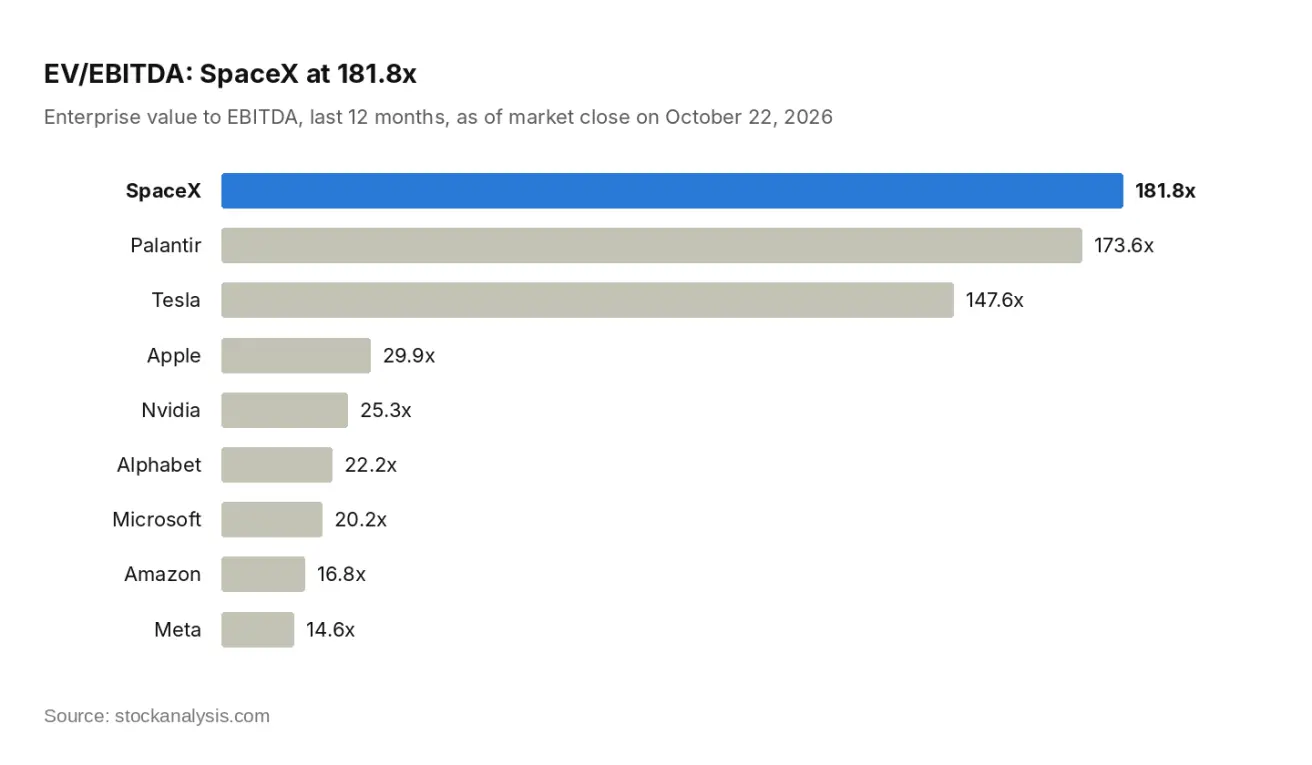
To understand whether the company is expensive, investors often look at the EV/EBITDA multiple: it shows how many times the value of the business exceeds its EBITDA. By this metric, SpaceX is significantly more expensive than the largest technology companies.
Part of the difference is explained by growth rates: SpaceX’s revenue grew by 161% over the year, while most of the largest technology companies grew by 16–26% for comparison.
SpaceX’s price likely also includes premiums that are not visible in the financial statements: for Elon Musk’s persona, leadership in space launches, the prospects of the artificial intelligence segment, and a possible merger with Tesla.
Debt and new financing
At the end of September, SpaceX’s debt stood at about $39 billion, while cash and securities totaled about $90 billion. Most of the debt consists of $25 billion in bonds with an average rate of 5.855% and the first maturity in July 2031. In addition, the company has committed to pay about $38 billion under equipment purchase and cloud capacity lease agreements that it cannot walk away from.
Particular attention should be paid to $12.9 billion, or one-third of SpaceX’s debt, raised from Valor Equity Partners. The fund is led by Antonio Gracias, a member of SpaceX’s board of directors. At the beginning of the year, debt to Valor stood at $4,507 million.
The financing is structured as a sale of servers followed by a sale-leaseback: Valor buys the equipment, and SpaceX continues to use it and pays rent. The fund’s involvement, led by a member of SpaceX’s board, raised questions about a conflict of interest.
On October 26, after the report was published, SpaceX announced that it had raised another $40 billion or so through a vehicle managed by Apollo. The fund will buy chips and servers and lease them to SpaceX for 5 to 5.25 years. This will help finance investment, but it will also increase the company’s future obligations.
Management guidance
For the first quarter of 2027, CFO Bret Johnsen expects revenue of $33–37 billion, 2.26–2.54 times higher than in the third quarter. Johnsen also confirmed the goal of reaching an annualized revenue run rate of $100 billion by December 2026.
Elon Musk is much more optimistic: by the end of 2027, he expects to bring the annualized revenue run rate to $500 billion–$1 trillion, and to add another 10 GW of computing capacity during 2027. Capital expenditures will therefore remain high.
How the market reacted to the report
The market’s initial reaction was positive: on October 21, SpaceX shares rose by 7.8% to $159.31. The next day, they fell by 9.1% to $144.75. Motley Fool links the decline to profit-taking, the scale of capital expenditures, and the lifting of restrictions on the sale of part of insiders’ shares. The decline continued, and on October 30 the shares closed at $134.72, below the IPO price of $135.
Bank analysts, meanwhile, mostly raised their target prices for SpaceX shares. JPMorgan raised its target price from $240 to $500, Bernstein raised it from $248 to $267, and Morgan Stanley kept its previous target of $300. The new target prices range from $224 (TD Cowen) to $500 (JPMorgan).
Lockup expiration: phased exit
After the IPO, restrictions on the sale of SpaceX shares are lifted in stages. A block of 1.3 billion shares became available for sale two trading days after the report was published. On December 8, the main 180-day lockup period expires, after which another 342 million shares can be sold. The largest block, 6.4 billion shares held by Elon Musk, will be released on June 12, 2027.
Conclusion
In the third quarter, the artificial intelligence segment became SpaceX’s main source of revenue, and the company posted operating profit for the first time since the IPO. Such growth requires heavy investment: over nine months, capital expenditures exceeded operating cash flow by about $35 billion.
In the coming months, investors will watch revenue in the artificial intelligence segment, capital expenditures versus fourth-quarter guidance, the rollout of new capacity, and financing terms. The next report will show whether SpaceX can sustain the growth rates embedded in its market valuation.
Want to learn how pre-IPO investments in technology companies work? Leave a request in the Raison bot, and our experts will contact you.